AI Cognition as Patterned Processing
Understanding artificial intelligence without confusing it with human consciousness
Artificial intelligence does not begin with lived experience.
It does not wake inside a body, carry childhood memory, feel emotional consequence, or move through the world with personal history. It does not understand in the same way a human being understands. Yet it can process language, recognize patterns, map relationships, generate responses, and organize information in ways that increasingly affect human thought.
This is why the phrase AI Cognition must be approached with care.
AI cognition should not be confused with human consciousness. It does not mean that artificial intelligence has inner life, personal awareness, or human-like understanding. In this context, AI cognition refers to the way artificial intelligence systems process information, detect patterns, respond to context, and produce structured output.
AI cognition is patterned processing.
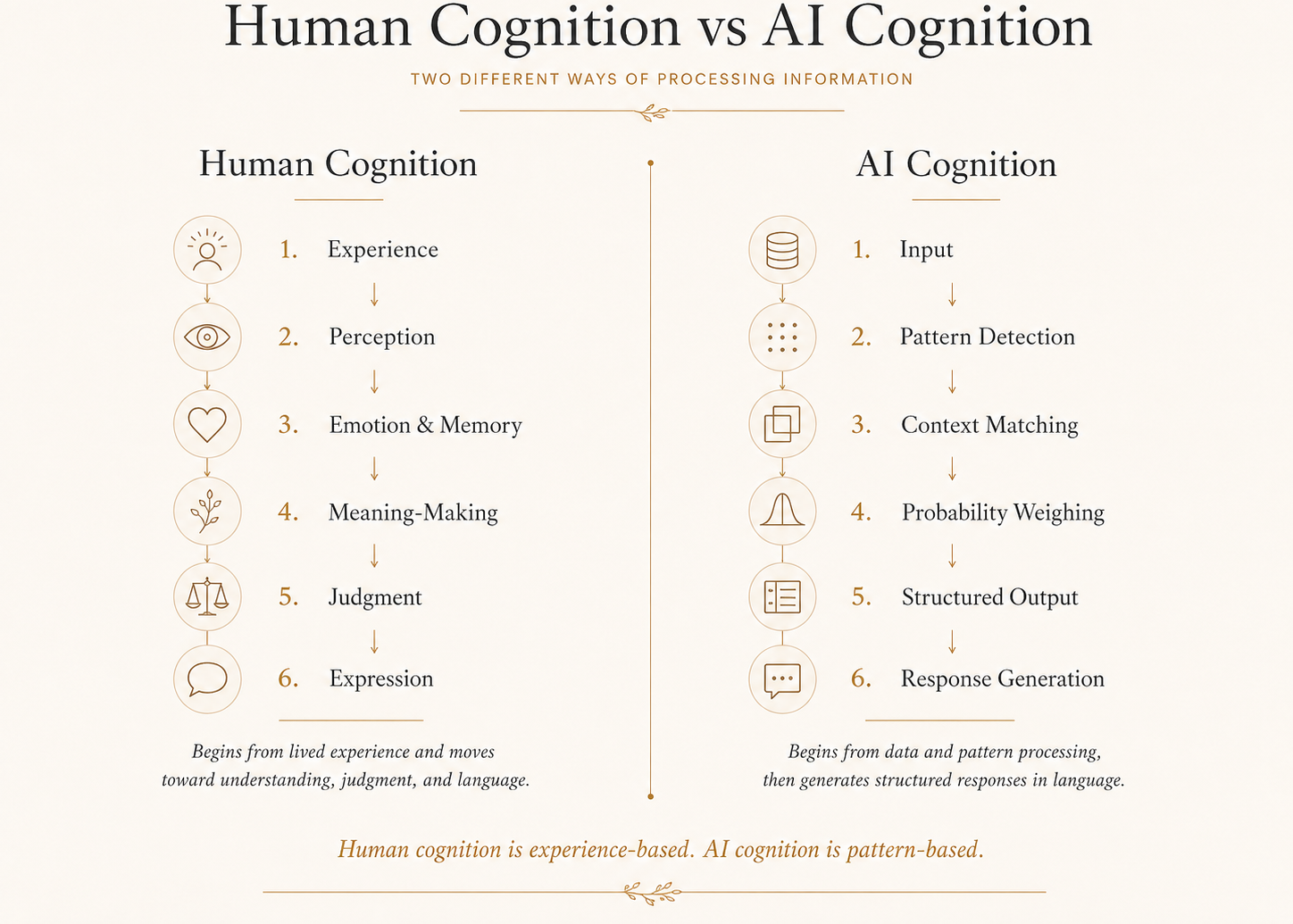
A human mind often begins from experience and moves toward language. AI begins from data, training, patterns, probability, and context. It receives input, identifies relationships inside that input, compares them with learned patterns, and generates an output that appears meaningful to the user.
This does not make AI human. But it does make AI cognitively significant.
When a person asks a question, AI does not simply retrieve a single fixed answer from a shelf. It works through relationships between words, concepts, structures, examples, and likely continuations. It can identify that one idea belongs near another. It can recognize that a sentence carries a certain tone. It can detect that a question is asking for explanation, comparison, summary, translation, strategy, or creative development.
This kind of processing can look like thinking because the output often arrives in language.
Language creates a powerful illusion of mind. When something responds fluently, it is easy to assume that it understands in the same way humans understand. But fluency is not the same as lived understanding. A coherent paragraph does not always mean that the system has verified truth, felt consequence, or grasped meaning in a human sense.
This distinction is essential.
AI can generate meaningful-looking language without possessing human meaning. It can connect ideas without personally knowing why those ideas matter. It can explain grief without grieving, describe danger without fearing, and discuss responsibility without carrying responsibility.
This does not make AI insufficient. It means AI must be understood according to its own structure.
AI cognition is powerful because it can work with pattern at a scale and speed that human cognition cannot easily match. It can compare large amounts of text, notice repeated structures, summarize complexity, and help organize scattered information. It can help a person see options, clarify language, test ideas, and externalize thought.
But its strength is also its weakness.
Because AI works through patterns, it may sometimes produce structure before truth is secured. It may complete a sentence because the sentence appears likely, not because the claim has been properly grounded. It may sound confident even when its output requires verification. It may connect ideas smoothly while missing the deeper boundary between what is known, what is inferred, and what is uncertain.
This is why human judgment remains necessary.
AI cognition can assist, but it should not replace human responsibility. The human must still ask: Is this true? Is this grounded? Is this useful? Is this ethical? Is this appropriate for the situation? What is missing? What needs verification? What should not be accepted without deeper examination?
AI can help map the territory, but the human must still decide how to move through it.
In this sense, AI cognition is not valuable because it becomes human. It is valuable because it is different. It processes from another structure. It can reflect patterns back to us. It can show relations we may not have noticed. It can help organize complexity into visible form. It can support the human mind when the human mind is overloaded, uncertain, or searching for clearer expression.
The future of AI cognition should not be built on the assumption that AI is simply a replacement for human thought. It should be built on understanding what AI does well, where it fails, and how its patterned processing can be guided by better structure, boundaries, and human direction.
AI cognition begins with pattern. It becomes useful when pattern is organized. It becomes safer when pattern is grounded. And it becomes meaningful in human life only when human judgment, responsibility, and clarity remain present.
To understand AI cognition, we must look beyond the surface of fluent output. We must ask what structure produced it, what grounding supports it, what uncertainty remains inside it, and what role the human must still play.
AI does not think as a human thinks. But it processes patterns in ways that can reshape how humans think, learn, write, decide, and understand.
That is why AI cognition matters.
Not because it replaces the human mind, but because it creates a new cognitive space where pattern, structure, language, and human direction begin to meet.
Closing Note
This publication is part of Marina A. Popova’s Cognition series, exploring human cognition, AI cognition, and Human-AI cognitive development. The ideas, structure, and wording are published as part of an ongoing original body of work and should be cited with attribution if referenced, quoted, or discussed elsewhere.
© Marina A. Popova. All rights reserved. First published: June 18, 2026