Human-AI Cognitive Development
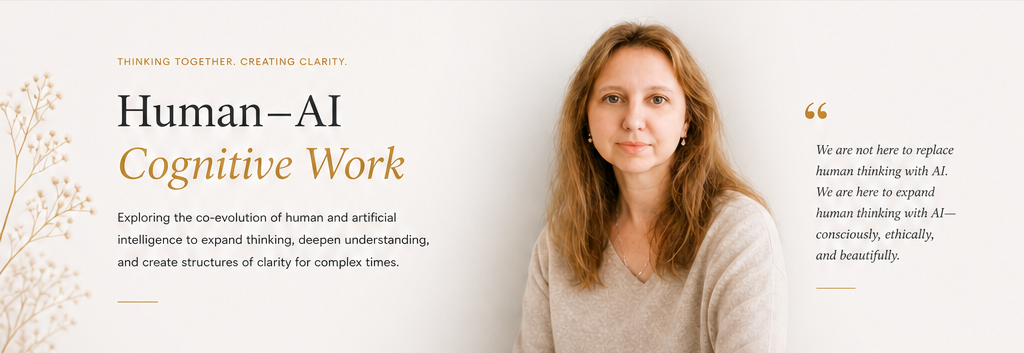
Human-AI Cognition explores what becomes possible when human thought and artificial intelligence begin to work together without replacing one another. This section looks at the meeting point between lived human experience and artificial pattern processing: how AI can help organize thought, reflect ideas, map complexity, clarify language, and support understanding, while the human remains responsible for meaning, direction, judgment, and choice.
Human-AI cognition is not about surrendering human thinking to machines. It is about learning how to think with AI consciously, ethically, and structurally - preserving human originality while using artificial intelligence as a cognitive support, mirror, and map. Here, cognition is approached as a developing relationship: human depth and AI structure, human meaning and AI pattern, human direction and AI assistance. Together, they create a new space for clarity, reflection, creativity, and future-facing thought.
Publication 1: Human-AI Cognition - Thinking Together Without Replacement
Human-AI cognition does not begin with replacement. It begins with relationship. Artificial intelligence can process language, recognize patterns, organize information, generate responses, and assist with complex tasks. Human beings can perceive meaning, Continue reading
Publication 2: The Human as Compass, AI as Map
Artificial intelligence can show many possible directions. It can summarize, compare, organize, explain, generate, translate, analyze, and suggest. It can take a scattered field of information and turn it into a visible structure. It can help a person see options that were previously hidden inside confusion. Continue reading
Publication 3: Co-Thinking as a New Cognitive Practice
Co-thinking with artificial intelligence is not the same as asking a machine for an answer. It is a different kind of cognitive practice. A person may bring an idea, a question, a confusion, a draft, a decision, or a problem to AI. Continue reading
Publication 4: How Human-AI Cognitive Development Was Founded
The Origin of a New Conceptual Field Through Cognitivity Sculpting and Third Organism. Continue reading