Cognitive Stationery
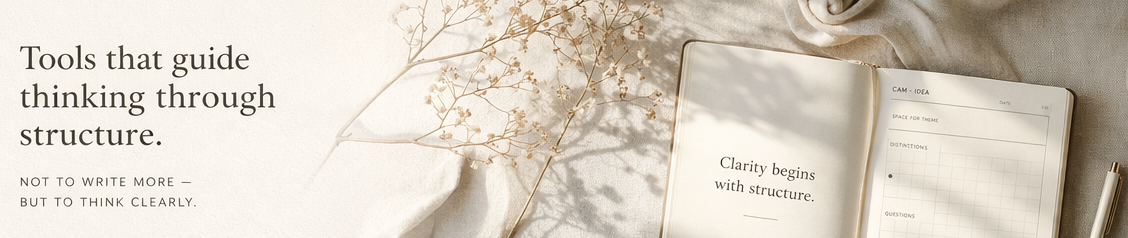
Cognitive Stationery explores a simple question: What if thinking itself could be supported through physical tools?
For centuries, we have created tools for writing, planning, recording, and learning. Yet very few tools have been designed specifically to help structure thought. Cognitive Stationery is an exploration of methods, journals, layouts, and cognitive supports intended to assist clarity, reflection, problem-solving, and idea development. This category documents that exploration.
Publication 1: Cognitive Stationery - Preserving Structured Thinking Beyond Tools
Cognitive Stationery began as a practical idea. At first, it appeared as a way to support thinking through physical pages, templates, visual structures, and guided layouts. It belonged to the practical side of the Third Organism ecosystem: a bridge between cognition and paper, between abstract thought and visible form. But over time, its deeper purpose became clearer. Continue reading
Publication 2: Why We Have Tools for Writing but Not Tools for Thinking
We have many tools for writing. Notebooks, journals, planners, digital documents, calendars, note-taking apps, task lists, templates, and systems designed to help us record what we think. We also have tools for planning. Continue reading
Publication 3: The Difference Between Recording Thoughts and Structuring Them
A thought can be written down without becoming clear. This is one of the quiet problems hidden inside ordinary notebooks, journals, planners, and digital documents. They allow us to record what is moving through the mind. But recording is not the same as structuring. Continue reading
Publication 4: Assisted Intelligence on Paper
When people hear the phrase Assisted Intelligence, they often think of technology. A digital assistant. An application. An algorithm. A system that responds, recommends, predicts, or generates. But assistance does not have to be digital. Sometimes assistance can be structural. Continue reading
Publication 5: From Notebook to Cognitive Interface
A notebook is one of the simplest tools humans have created. It gives thought a place to land. A page can hold memory, language, sketches, questions, plans, emotions, unfinished ideas, and fragments of experience. For centuries, the notebook has served as a companion to thinking. Continue reading