Anchor-Based Logical Clarity
Clear thinking does not always begin by adding more thoughts. Sometimes it begins by finding the right anchor. When a person feels confused, the mind often tries to solve the whole situation at once. It may bring in more explanations, more memories, more worries, more possible outcomes, and more questions. But more thinking does not always create more clarity. Sometimes more thinking only creates more noise.
Anchor-Based Logical Clarity begins from a different direction.
Instead of asking the mind to explain everything, it asks the mind to find the most important point inside the confusion. That point becomes an anchor.
What Is an Anchor?
An anchor is a word, phrase, fact, question, need, limit, or direction that gives thinking something stable to hold. It is not the whole solution. It is not the whole problem. It is the point that helps the mind stop floating. For example, a person may think:
“I don’t know what to do because everything is too much, I am tired, I need to make money, and I am afraid I will choose the wrong direction.”
This sentence feels heavy because many things are mixed together. But inside the sentence, there are possible anchors:
Direction.
Pressure.
Tiredness.
Money.
Fear.
Choice.
Each anchor gives the mind a different place to begin. Without anchors, the sentence feels like one large problem. With anchors, the sentence begins to show its structure.
An Anchor Gives Thinking a Handle
When a thought is too broad, the mind cannot hold it clearly. For example:
“My life is confusing.”
This sentence may feel true, but it is too large to work with directly. The mind needs a handle. A handle may be:
Decision.
Work.
Money.
Time.
Health.
Relationship.
Direction.
Fear.
Once the anchor is found, the mind can ask a better question. If the anchor is “decision,” the question may become:
“What decision am I actually need to make?”
If the anchor is “money,” the question may become:
“What money issue needs attention first?”
If the anchor is “fear,” the question may become:
“What am I afraid may happen?”
The anchor does not solve the problem by itself. But it tells the mind where to look.
Anchors Reduce Mental Noise
Mental noise grows when too many thoughts are treated as equally important at the same time. The mind may not know which thought is urgent, which thought is emotional, which thought is practical, and which thought is only repeating fear. Anchor-Based Logical Clarity helps reduce this noise by asking: “What is the main anchor inside this sentence?”
Or: “What are the separate anchors inside this problem?”
For example: “I feel behind, I need to decide what to do next, and I am afraid I am wasting time.”
This can be separated into anchors:
Behind.
Decision.
Time.
Fear.
Now the mind can begin to work more clearly.
“Behind” may need comparison to be checked.
“Decision” may need options to be named.
“Time” may need a realistic boundary.
“Fear” may need to be separated from fact.
The original sentence is still meaningful, but it is no longer shapeless.
Anchors Help the Mind Ask the Right Question
A question becomes clearer when it is attached to the right anchor. Without an anchor, the question may become too wide:
“What should I do with my life?”
With an anchor, the question becomes more usable:
“What decision needs to be made this week?”
Without an anchor:
“Why am I so stuck?”
With an anchor:
“What part of this situation is actually not moving?”
Without an anchor:
“How do I fix everything?”
With an anchor:
“What needs attention first?”
The anchor narrows the entrance point. It does not reduce the importance of the situation. It simply makes thinking possible.
Not Every Anchor Has the Same Function
Some anchors point to action; some anchors point to a question. Some anchors point to a feeling; some anchors point to a fact. Some anchors point to missing information; some anchors point to a limit.
For example: “The deadline is Friday.” This is a fact anchor.
“I feel afraid.” This is an emotional anchor.
“I need to choose between two options.” This is a decision anchor.
“I do not know enough yet.” This is an information anchor.
“I cannot do both today.” This is a limit anchor.
When the mind knows what kind of anchor it is holding, it can respond more accurately.
A fact may need organization. A feeling may need acknowledgment. A decision may need comparison. Missing information may need research. A limit may need acceptance or prioritizing. The anchor helps the mind choose the right kind of thinking.
Anchor-Based Clarity Does Not Add Noise
Many thinking methods try to expand the situation first. They ask for more ideas, more possibilities, more explanations, more options, or more interpretations. Expansion can be useful in some situations. But when the mind is already overloaded, expansion can make confusion worse. Anchor-Based Logical Clarity begins by reducing. It asks:
“What is the anchor?”
“What can be removed?”
“What is noise?”
“What is the actual point?”
This is not about thinking less. It is about thinking more accurately. The mind does not need to carry the whole cloud at once. It only needs to find the stable point that allows the next step to become visible.
The Difference Between an Anchor and a Conclusion
An anchor is not a conclusion. This distinction is important. For example:
“I am failing.”
This sounds like a conclusion. But if we look carefully, the anchor may be:
Result.
Expectation.
Method.
Delay.
Fear.
Comparison.
The sentence “I am failing” may be too broad and too final. But the anchors inside it can help the mind investigate:
“What result did I expect?”
“What result did I actually get?”
“What method did I use?”
“What is delayed?”
“What fear is inside this thought?”
“What comparison am I using?”
The anchor opens the thought. The conclusion closes it too early.
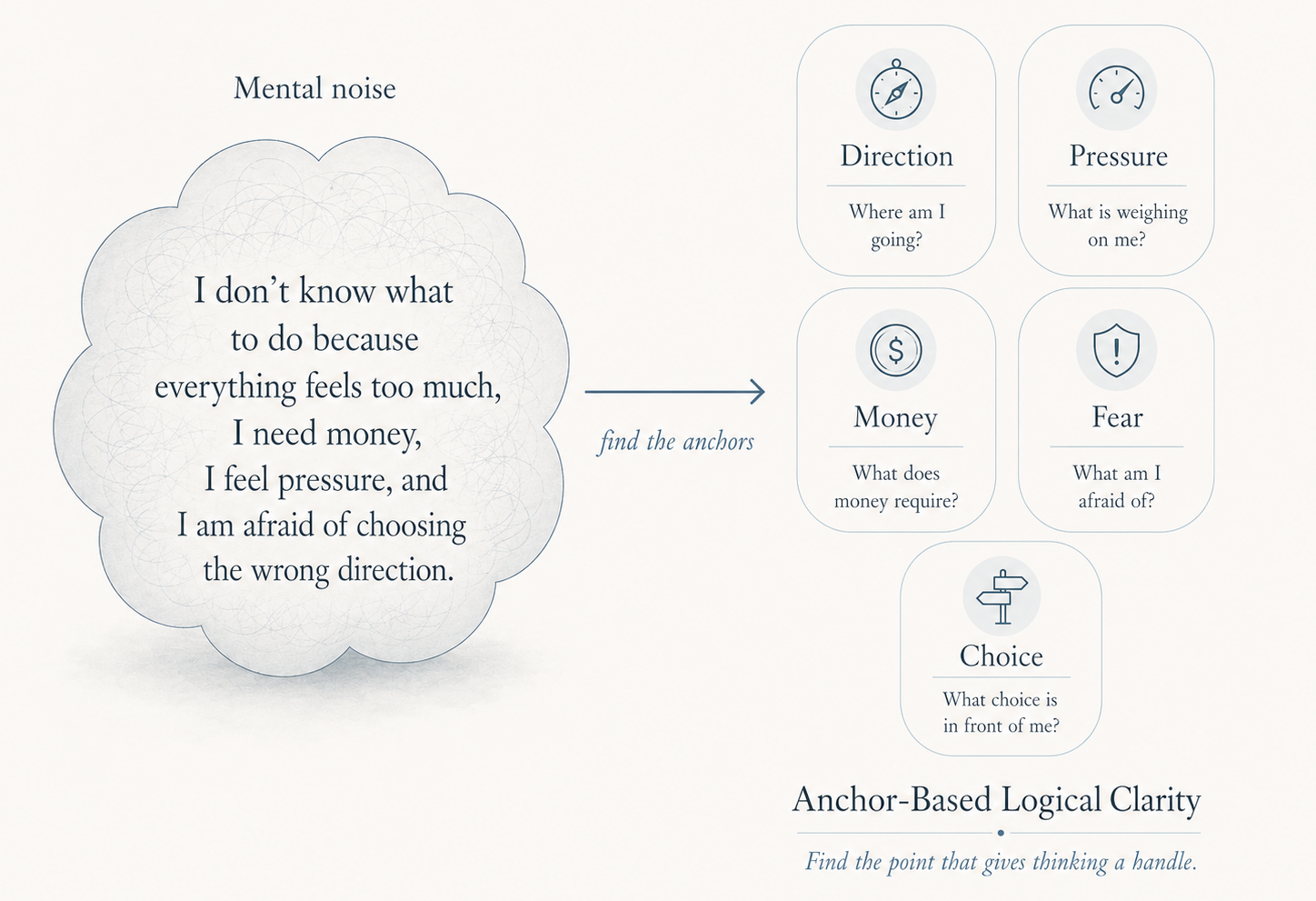
A Simple Practice
When you feel confused, write the sentence that is moving through your mind. Then ask:
“What is the anchor inside this?”
If there is more than one anchor, list them. For example:
“I don’t know what to do, I feel pressured, and I am afraid of choosing wrong.”
Possible anchors:
Direction.
Pressure.
Fear.
Choice.
Then choose one anchor to begin with. Ask:
“Which anchor needs attention first?”
This question helps the mind stop trying to solve the whole sentence at once. It gives thinking a starting point.
Final Thought
Anchor-Based Logical Clarity is a way of helping the mind move from mental noise into structure. It does not begin by adding more thoughts. It begins by finding the point that matters. An anchor gives thinking a handle. A handle gives thinking direction.
And once thinking has direction, clarity can begin.
Closing Note
This publication is part of Marina A. Popova’s “How to Think: A Practical Guide to Logical Clarity” series, exploring human cognition, AI cognition, and Human-AI cognitive development, structured questions, practical logic, and advanced cognitive methods. The material is shared here as part of this continuing development, before its future selection and refinement into book form.
The ideas, structure, and wording are published as part of an ongoing original body of work and should be cited with attribution if referenced, quoted, or discussed elsewhere.
© Marina A. Popova. All rights reserved. First published: June 17, 2026