Assisted Intelligence on Paper
When people hear the phrase Assisted Intelligence, they often think of technology.
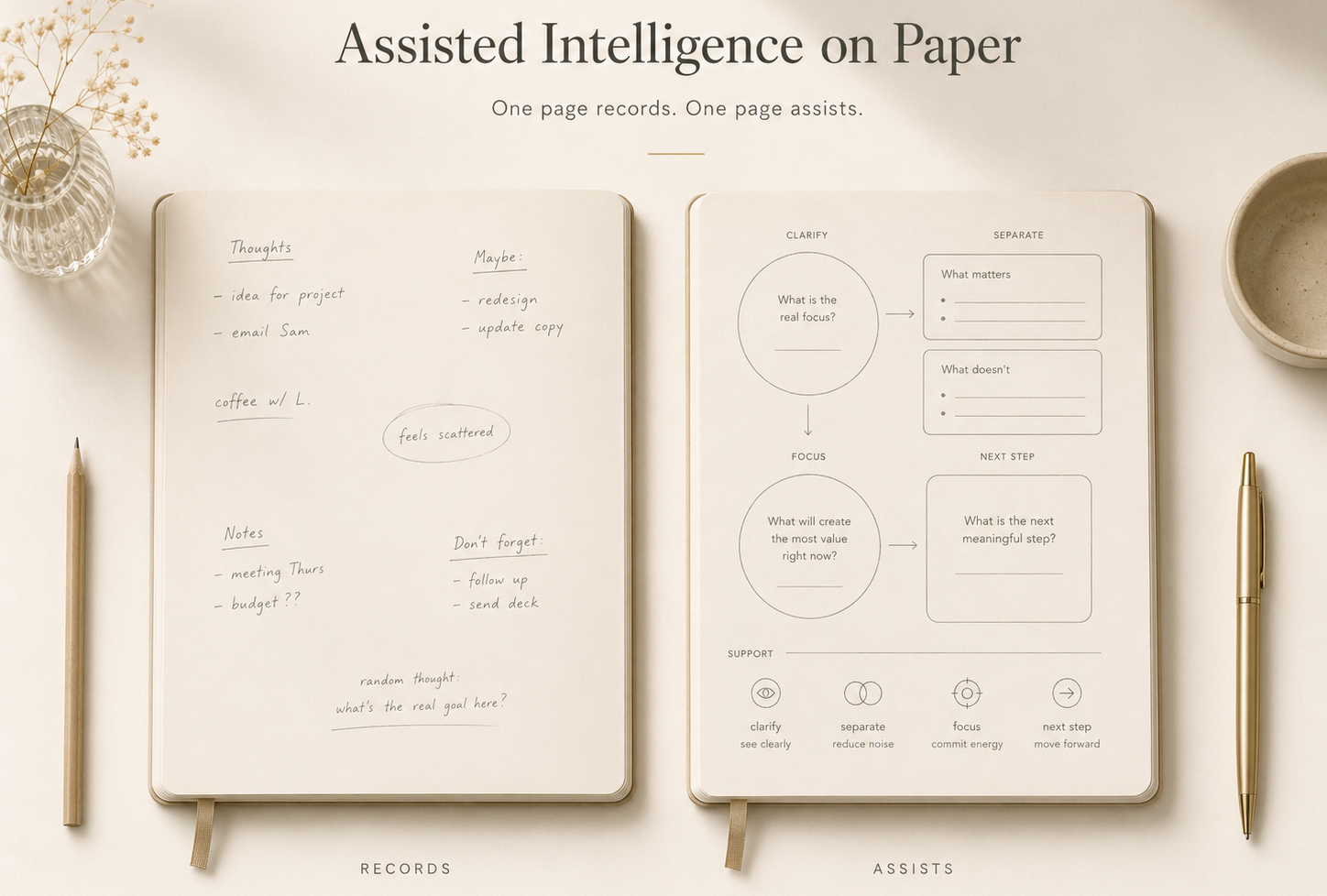
A digital assistant. An application. An algorithm. A system that responds, recommends, predicts, or generates. But assistance does not have to be digital. Sometimes assistance can be structural. Sometimes a page can assist the mind, not by answering for it, but by guiding how the mind moves.
This is the idea behind Assisted Intelligence on paper.
The Page as a Guide
Most paper tools are passive. They wait for the user to bring clarity.
A notebook waits for a thought. A journal waits for reflection. A planner waits for decisions. A task list waits for priorities. But thinking does not always arrive already formed. Often, a thought arrives unfinished. It may be scattered, emotional, overloaded, fragmented, or mixed with other thoughts.
A passive page can hold that confusion. But an assisted page can help separate it.
Assistance Without Replacing Thought
Assisted Intelligence on paper does not mean that the tool thinks instead of the person. That would remove the person from the process. Instead, it means the page supports the person while thinking is happening.
It can ask the next useful question, it can create a boundary. It can slow expansion, it can separate one layer from another. It can help a person see whether they are dealing with an idea, a problem, a risk, an opportunity, or an action.
This kind of assistance is quiet. It does not interrupt. It does not generate noise. It does not compete with the mind. It gives the mind a path.
Why Physical Assistance Matters
Digital tools are powerful. They can search, summarize, generate, compare, and respond. But they can also overwhelm. They often introduce more information before the person has organized what is already present.
Physical tools behave differently. A page does not rush. A page does not notify. A page does not scroll. A page holds one space at a time. That slowness matters. For some forms of thinking, slowness is not a limitation.
It is protection.
Structure as Assistance
A line can guide attention. A circle can hold a central idea. A box can contain uncertainty. A sequence can move thought forward. A boundary can prevent unnecessary expansion. A blank area can create space for what has not yet been understood.
These are simple forms. But when arranged with cognitive intention, they become more than design. They become assistance. Not assistance that tells the person what to think. Assistance that helps the person think with more precision.
The Difference Between Prompting and Supporting
Many journals use prompts. A prompt asks a question. That can be useful. But a single question does not always create structure. A person may answer the prompt and still remain unclear. Cognitive support requires more than a question. It requires a relationship between parts:
What is central?
What is surrounding it?
What belongs inside the idea?
What should remain outside?
What needs to be compressed?
What can be acted on?
A structured page does not simply ask. It organizes the conditions for thought to continue.
Assisted Intelligence as Training
The deeper purpose is not dependency. The purpose is training. When a person repeatedly uses structured tools, the mind begins to recognize patterns of clarity. It learns to compress. It learns to separate. It learns to identify anchors. It learns to distinguish noise from structure. It learns where thought becomes action.
Over time, the page is no longer only an external support. It becomes a training surface for internal cognition.
Why This Belongs to Cognitive Stationery
Cognitive Stationery explores the possibility that physical tools can support thinking before it becomes writing, planning, or execution. It does not treat stationery as decoration. It treats physical form as a cognitive environment. A notebook records. A planner schedules. A cognitive page assists.
This is the difference.
Assisted Intelligence does not always need to speak. Sometimes it can exist quietly on paper. In the shape of a question. In the placement of a boundary. In the sequence of a page. In the space that helps thought become clear.
Cognitive Stationery begins from this possibility: that a page can become a silent partner in thinking.
Closing Note
This publication is part of Marina A. Popova’s Cognitive Stationery series, exploring cognitive development through physical tools. The ideas, structure, and wording are published as part of an ongoing original body of work and should be cited with attribution if referenced, quoted, or discussed elsewhere.
© Marina A. Popova. All rights reserved. First published: June 24, 2026