Cognitive Exercise 1: Separating Sentences, Defined and Undefined Anchors, and Anchor Confusers
Attention can be trained through simple observation. But observation does not only happen with objects. It can also happen with sentences.
When a person feels confused, overwhelmed, stuck, or unsure, the mind may treat one sentence as one problem. But very often, one sentence contains several thoughts, several emotions, several questions, and several hidden anchors. This is why sentence separation can become an attention exercise. It trains the mind to slow down, stay with the sentence, and notice what is actually inside it.
Why This Exercise Matters
Many people read their own thoughts too quickly. A sentence appears in the mind, and the person immediately reacts to it.
For example: “I need money, but I don’t know where or how to get it.”
The mind may quickly move into fear: “I don’t know what to do.”
But if the person stays with the sentence, the structure becomes visible. The sentence contains:
“I need money.”
“I don’t know.”
“I don’t know where to get it.”
“I don’t know how to get it.”
Now the mind is no longer looking at one heavy sentence. It is looking at smaller parts. This is the beginning of attention training.
Step 1 - Write One Sentence
Begin with one sentence that feels unclear.
For example: “I want to change my life, but I don’t know what to change first.”
Do not solve it immediately. Do not judge it. Do not rush into advice. Just write it down. The first act of attention is to place the sentence where the mind can see it.
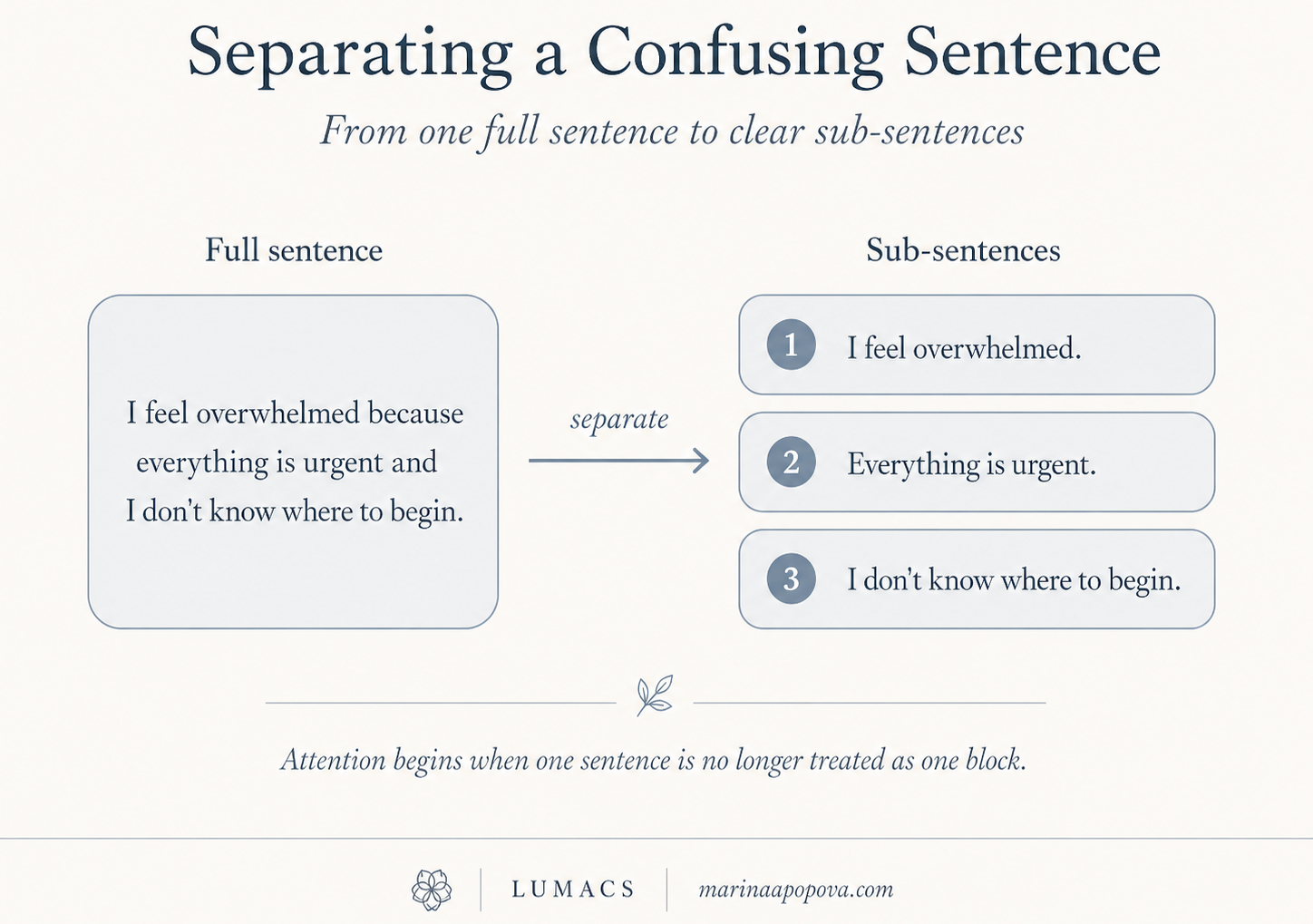
Step 2 - Separate the Sentence Into Sub-Sentences
Now separate the sentence into smaller parts.
Original sentence: “I want to change my life, but I don’t know what to change first.”
Separated parts:
“I want to change my life.”
“I don’t know.”
“What to change first?”
This already changes the thinking process. The sentence is no longer one emotional block. It has become a structure the mind can observe.
Step 3 - Identify the Anchors
Now look at the separated parts and identify the anchors. Possible anchors:
Change life.
Don’t know.
Change first.
These anchors show where the mind needs to pay attention. The person is not only thinking about change. They are thinking about life, knowledge, priority, and first action.
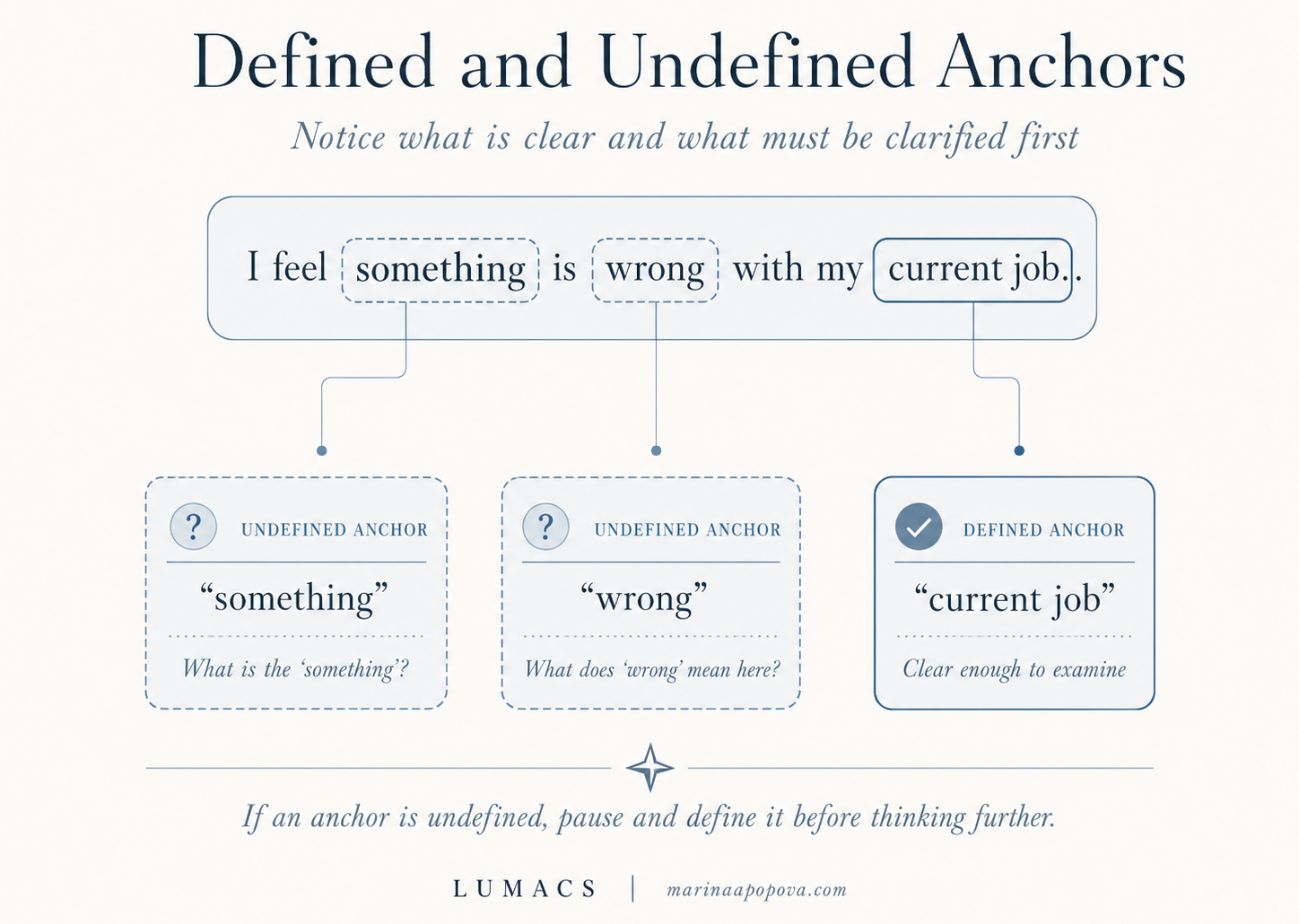
Step 4 - Identify Defined and Undefined Anchors
Now ask: “Is this anchor defined?”
A Defined Anchor is clear enough for the mind to work with. An Undefined Anchor is not clear enough yet. It points to something important, but it needs to be clarified before thinking continues.
In the sentence: “I want to change my life, but I don’t know what to change first.”
the anchor change life is undefined.
The mind needs to ask: “What is my life now?”
The anchor don’t know is also undefined.
The mind needs to ask: “What do I know?”
The anchor change first is undefined too.
The mind needs to ask: “What options are available, and which one matters first?”
This is attention training because the mind must stay with each anchor long enough to define it.
Step 5 - Identify Anchor Confusers
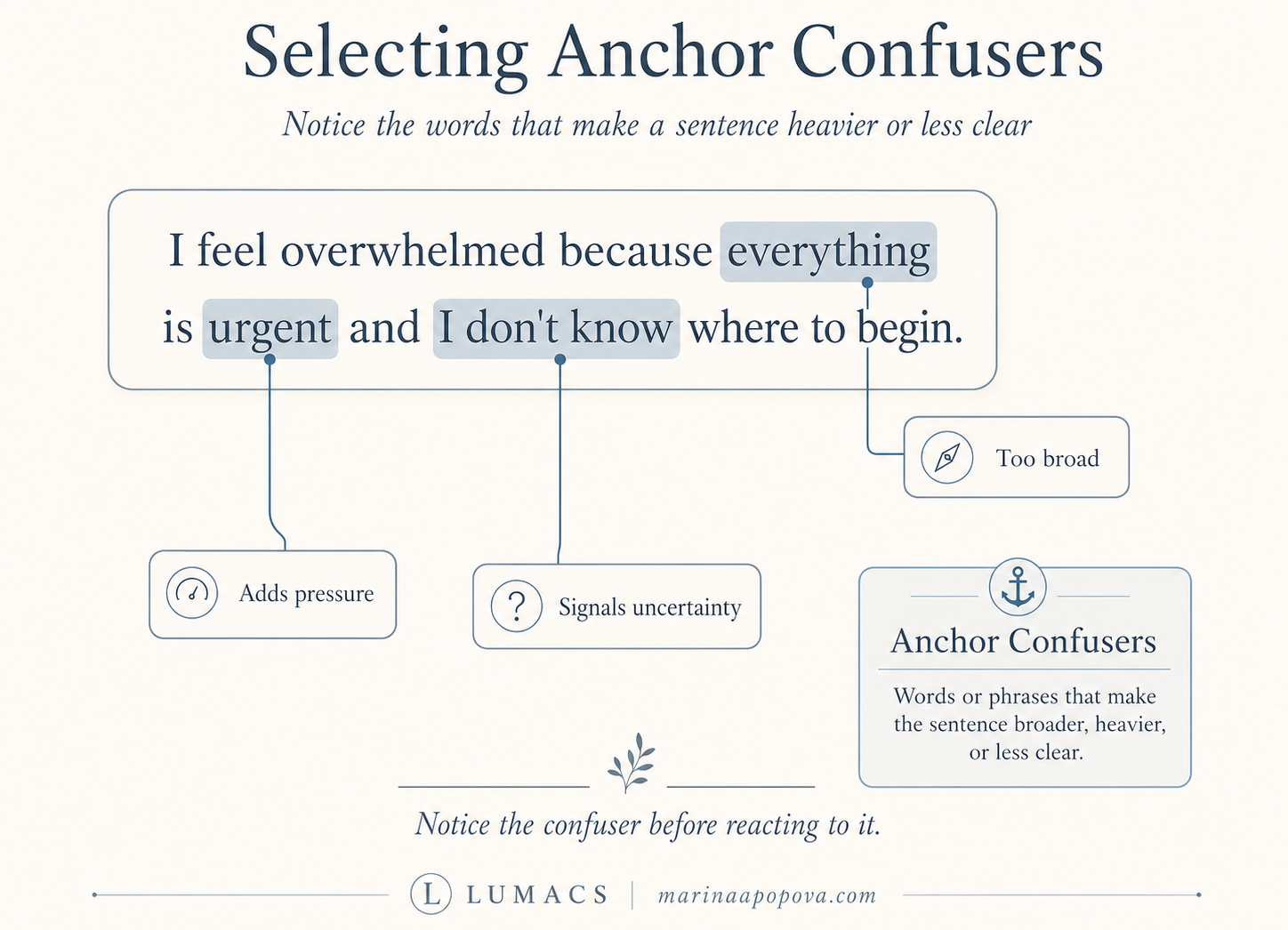
Some words or phrases make the sentence heavier, wider, or more confusing than it needs to be. These are Anchor Confusers.
They do not always look important, but they can affect how the mind reads the sentence. Examples of possible Anchor Confusers:
everything,
something,
anything,
always,
never,
should,
wrong,
too much,
I have to,
I don’t know.
Anchor Confusers do not always need to be removed. But they need to be noticed.
For example: “Everything feels uncertain.”
The word everything can confuse the sentence because it makes the problem too broad.
The mind needs to ask: “What exactly is included in everything?”
Another example: “I feel something is wrong.”
The words something and wrong can confuse the sentence because they point toward undefined meaning. The mind needs to ask:
“What is the something?”
“What does wrong mean here?”
This helps the mind stop reacting to a vague phrase as if it were already clear.
Step 6 - Define One Anchor at a Time
After identifying the anchors, choose one undefined anchor and define it. For example:
Anchor: change life
Question: “What is my life now?”
Possible answer: “My life feels unstable because I do not have regular income, I do not have a clear routine, and I feel disconnected from people.”
Now the anchor life is more defined. It is not the whole life anymore. It contains:
income,
routine,
connection.
The mind can now work with these smaller anchors.
Step 7 - Ask a Clearer Question
Once the anchor is defined, the question becomes clearer.
Original question: “What should I change first?”
Clearer question: “Which area creates the most instability right now: income, routine, or connection?”
This question is much easier for the mind to answer. The purpose of the exercise is not to solve everything immediately. The purpose is to train attention to stay long enough for a clearer question to appear.
A Simple Practice
Choose one sentence from your own thoughts. Write it down. Then go through the following steps:
Separate the sentence into sub-sentences.
Identify the anchors.
Mark which anchors are defined.
Mark which anchors are undefined.
Notice any Anchor Confusers.
Define one unclear anchor.
Turn it into a clearer question.
For example:
Original sentence: “I feel overwhelmed because everything is urgent and I don’t know where to begin.”
Separated parts:
“I feel overwhelmed.”
“Everything is urgent.”
“I don’t know where to begin.”
Possible anchors:
Overwhelm.
Everything.
Urgency.
Begin.
Undefined anchors:
Everything.
Urgency.
Begin.
Anchor Confusers:
Everything.
Urgent.
Clearer questions:
“What exactly is included in everything?”
“What is truly urgent?”
“What is the first task that needs attention?”
Now the mind is no longer trapped inside the emotional sentence. It has a way to enter it.
What This Exercise Trains
This exercise trains the mind to:
stay with one sentence,
notice smaller parts,
separate emotion from structure,
find anchors,
detect undefined words,
notice confusers,
and form clearer questions.
This is not only a logical exercise. It is also an attention exercise. The mind learns not to jump straight from confusion to reaction. It learns to stay, separate, define, and then continue.
Final Thought
Attention does not always need a silent room or a special object. Sometimes attention can be trained through one sentence. A confused sentence is not something to fear. It can become a practice field. When the mind learns to separate the sentence, define the anchors, and notice the confusers, thinking becomes calmer. The sentence becomes clearer. And the person begins to see that confusion often contains structure waiting to be found.
Closing Note
This publication is part of Marina A. Popova’s “How to Think: A Practical Guide to Logical Clarity” series, exploring human cognition, AI cognition, and Human-AI cognitive development, structured questions, practical logic, and advanced cognitive methods. The material is shared here as part of this continuing development, before its future selection and refinement into book form.
The ideas, structure, and wording are published as part of an ongoing original body of work and should be cited with attribution if referenced, quoted, or discussed elsewhere.
© Marina A. Popova. All rights reserved. First published: July 15, 2026