Case Scenario 1 - When a Career Question Contains Several Problems
The initial confused sentence was:
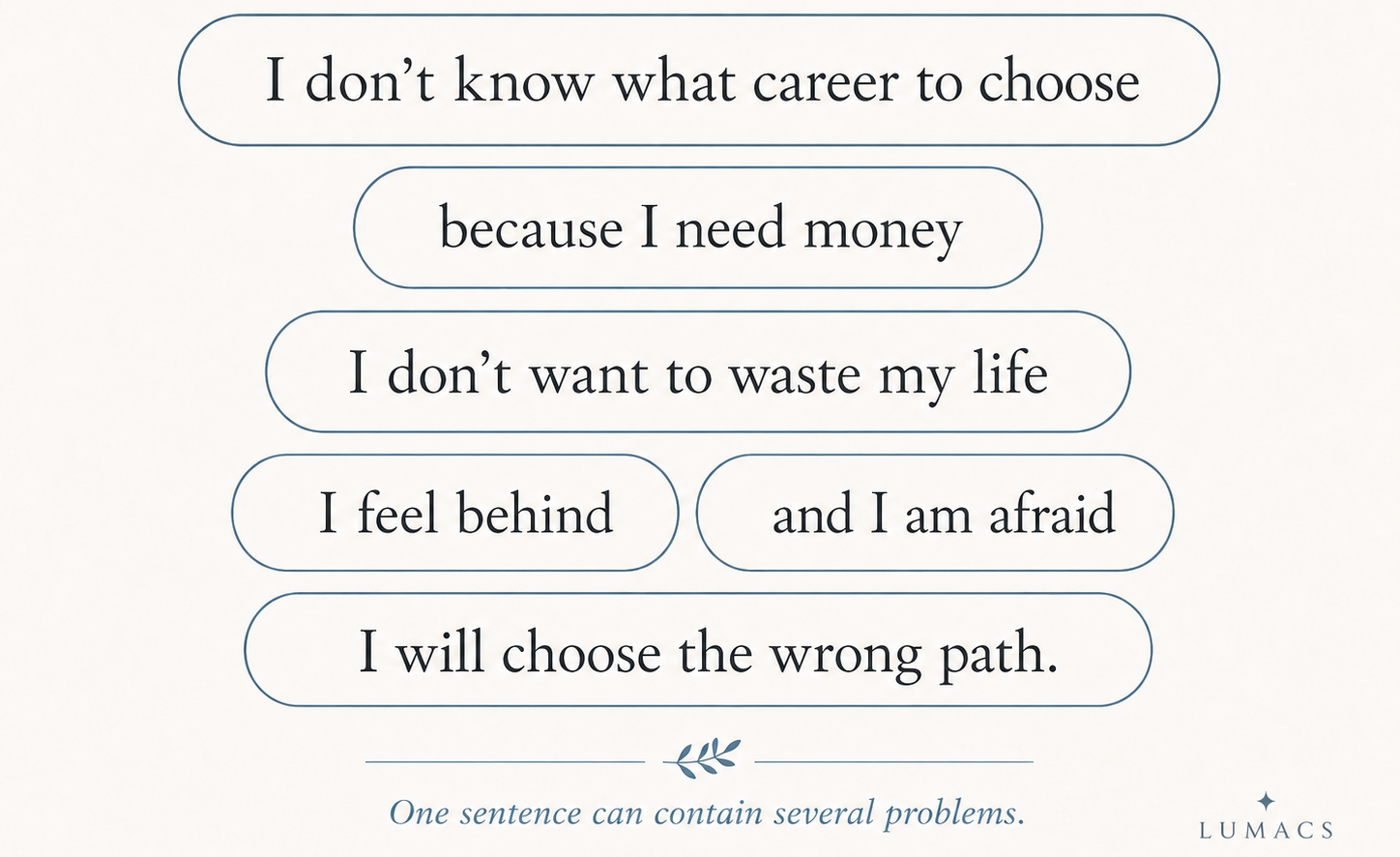
“I don’t know what career to choose because I need money, I don’t want to waste my life, I feel behind, and I am afraid I will choose the wrong path.”
At first, this sounds like one career question. But it is not one question. It contains several different parts: money pressure, life direction, timing pressure, fear, and decision uncertainty.
This question is too heavy. It asks the mind to solve money, identity, time, fear, and future direction all at once.
Step 1 - Segment confused sentence into sub-sentences
Step 2 - Extract the most visible anchors
Let’s try to extract the most visible anchors as short sentences:
Career choice.
Need money.
Life direction.
Time pressure.
Fear of missing out.
Wrong path choice.
These anchors show that the original sentence is not only about career. It also contains money, direction, timing, fear, and choice.
Step 3 - Compress the anchors
Next, let’s compress the anchors:
Career.
Money.
Direction.
Behind.
Fear.
Choice.
Now the problem is easier to see. The person is not only asking about career. They are also asking about financial stability, meaningful direction, comparison with time, and fear of regret. This is too much.
Step 4 - Connect compressed anchors with short anchor sentences
Next, let's connect the compressed anchors with their short anchor sentences:
Career → Career choice.
Money → Need money.
Direction → Life direction.
Behind → Time pressure.
Fear → Fear of missing out.
Choice → Wrong path choice.
Now the mind can see very clearly what each anchor is carrying.
Step 5 - Turn the anchors into clearer questions
Now we can segment the initial question into clearer questions because we understand what we actually need to ask ourselves:
“What career can support me financially right now?”
“What can I use to make money?”
“What direction of life would benefit me most?”
“What would help me move forward instead of staying behind?”
“What choice do I need to make from the options available to me?”
“Which available choice would benefit me most right now?”
These questions are clearer because each one is connected to a specific anchor.
Step 6 - Separate the urgent anchor from the emotional anchors
The next step is to separate the urgent anchor from the emotional anchors. In this scenario, one of the most important questions may be:
“Do I have enough savings to keep looking for my dream career?”
This is a critical question because without savings, the person may not be able to continue searching for a dream job without financial pressure. Without income, they may struggle to pay bills or support daily life.
So the question can be separated into two options:
Option 1: Yes, I have enough savings.
Option 2: No, I do not have enough savings.
From these two options, we now have two new anchors:
Anchor 1: Enough savings.
Anchor 2: Not enough savings.
Outcome
1) If the person has enough savings, they can begin looking for a career that may bring both satisfaction and money.
2) If the person does not have enough savings, they may need to find a temporary job to pay the bills while continuing to look for a dream career, or while getting education or training that can help them move toward that career in the future.
The original sentence was:
“I don’t know what career to choose because I need money, I don’t want to waste my life, I feel behind, and I am afraid I will choose the wrong path.”
But after anchor extraction and compression, the clearer understanding becomes:
“I need to separate money, direction, timing pressure, fear, and choice before deciding my next career step. The first practical anchor is whether I have enough savings to continue searching freely, or whether I need temporary income while building toward the career I want.”
Closing Note
This publication is part of Marina A. Popova’s “How to Think: A Practical Guide to Logical Clarity” series, exploring human cognition, AI cognition, and Human-AI cognitive development, structured questions, practical logic, and advanced cognitive methods. The material is shared here as part of this continuing development, before its future selection and refinement into book form. The ideas, structure, and wording are published as part of an ongoing original body of work and should be cited with attribution if referenced, quoted, or discussed elsewhere.
© Marina A. Popova. All rights reserved. First published: June 24, 2026