Case Scenario 4 - When Too Many Ideas Block Action
The confused sentence was:
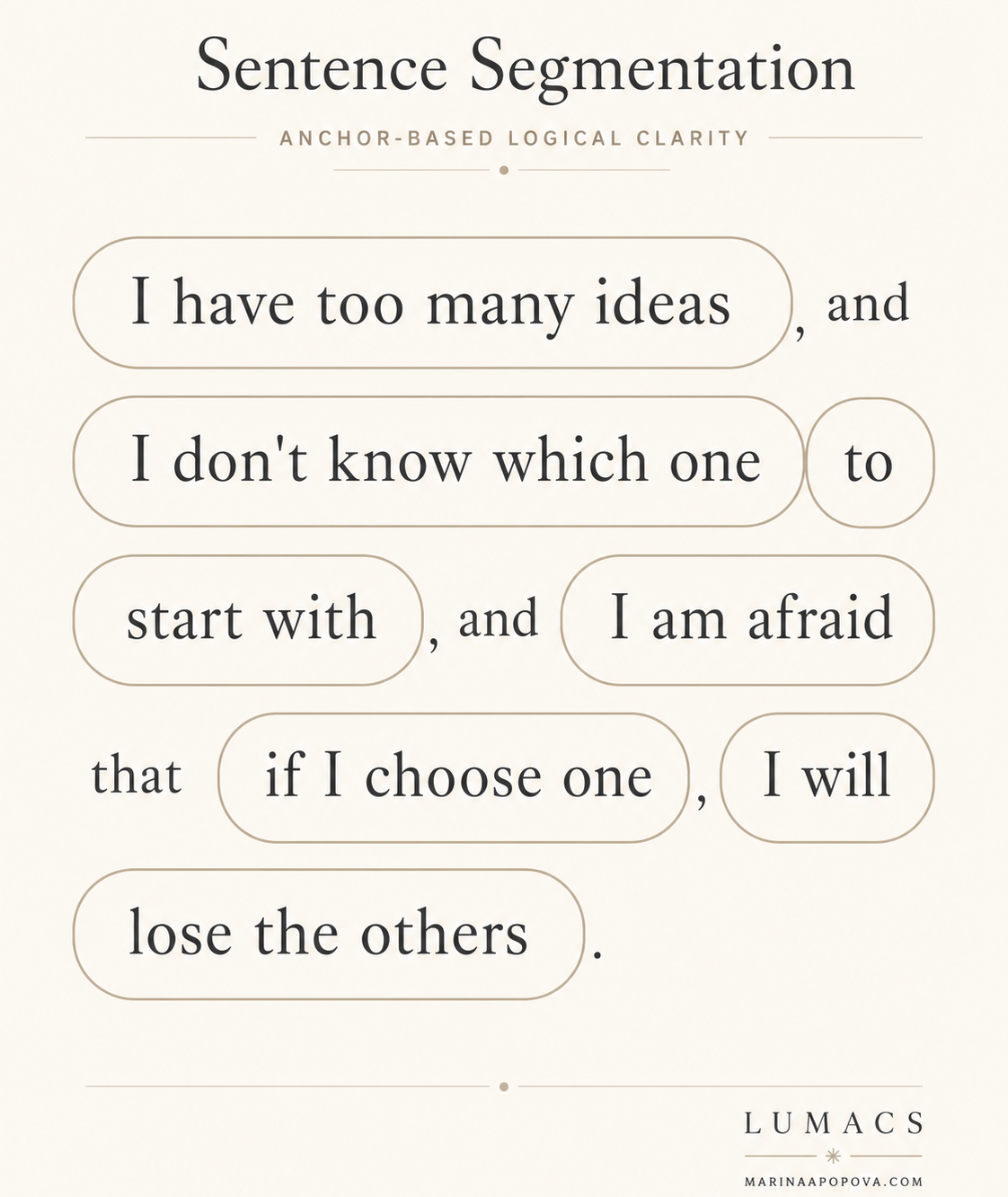
“I have too many ideas, and I don’t know which one to start with, and I am afraid that if I choose one, I will lose the others.”
At first, this sentence sounds like a creativity problem. But when we look closer, it is not only about ideas. It contains a tangled mind, decision uncertainty, fear of loss, and lack of a starting point. The person is not lacking ideas. The person is lacking a way to evaluate which idea is ready to begin first.
Step 1 - Separate the sentence into sub-sentences
The sentence can be separated into smaller parts:
“I have too many ideas.”
“I don’t know which one to start with.”
“I am afraid.”
“If I choose one.”
“I will lose the others.”
Now the mind can see the structure more clearly. The problem is not simply “too many ideas.” The problem is that the person believes choosing one idea may mean losing the others. This fear makes the mind tangled.
Step 2 - Extract and compress the anchors
After separating the sentence into sub-sentences, we can extract the visible anchors.
From: “I have too many ideas.”
the anchor is: Many ideas.
From: “I don’t know which one to start with.”
the anchors are: Unclear choice, Starting point.
From: “I am afraid.”
the anchor is: Fear.
From: “If I choose one.”
the anchor is: Choice.
From: “I will lose the others.”
the anchors are: Loss fear, Other ideas.
Now we can compress these anchors into shorter thinking handles:
Many ideas → Ideas
Unclear choice → Choice
Starting point → Start
Fear → Fear
Loss fear → Loss
Other ideas → Stored ideas
Now the mind can see the real structure of the problem:
The person has ideas, but does not know where to start.
The person needs to make a choice, but fear makes the choice feel like loss.
The other ideas do not need to disappear. They can become stored ideas.
This makes the next step clearer:
The person does not need to choose from panic.
The person needs to evaluate which idea is most ready to begin first.
Step 3 - Untangle the mind by listing all ideas
When the mind is tangled, the first step is not to choose immediately. The first step is to list everything clearly. For example, the person may write:
I want to open a cleaning business.
I want to open a beauty salon.
I want to begin a YouTube channel.
I want to create a digital product.
I want to open a tourist business.
Once the ideas are listed, they are no longer floating inside the mind. They are visible. And once they are visible, they can be evaluated.
Step 4 - Evaluate readiness
Now the person can ask: “How ready is each idea right now?”
A simple way to evaluate readiness is to use three practical anchors:
Knowledge.
Funds.
Time.
These anchors help the mind separate attractive ideas from ideas that are actually ready to begin. For example:
Cleaning business - 7/10
Knowledge: Yes.
Funds: No.
Time: Yes.
Beauty salon - 5/10
Knowledge: No.
Funds: No.
Time: Yes.
YouTube channel - 10/10
Knowledge: Yes.
Funds: Yes.
Time: Yes.
Digital product - 10/10
Knowledge: Yes.
Funds: Yes.
Time: Yes.
Tourist business - 5/10
Knowledge: No.
Funds: No.
Time: Yes.
Now the mind has more than a list. It has a readiness structure.
Step 5 - Identify the strongest fit
The results show that the strongest fit options to begin with are:
YouTube channel.
Digital product.
These ideas are not only attractive. They are also more ready because the person has the knowledge, the funds, and the time to begin.
The cleaning business may still be possible later.
The beauty salon and tourist business may also remain future possibilities.
But they are not the strongest first step right now. This is important because choosing one idea first does not mean losing the other ideas. It only means choosing the most ready idea to begin with.
Step 6 - Combine compatible ideas
Sometimes the solution is not to choose one idea and abandon the rest. Sometimes two ideas can support each other. In this scenario, the person can combine the two strongest ideas:
YouTube channel + digital product.
For example, the person may create a YouTube channel about exploring, researching, and learning how to open different kinds of businesses. The channel can include topics such as:
how to open a cleaning business,
how to open a beauty salon,
how to open a tourist business,
how to evaluate business readiness,
how to choose a first business idea.
Then the person can create a digital product connected to the same topic. For example:
a simple business-readiness checklist,
a beginner guide to choosing a first business idea,
a planning workbook for people with many ideas,
or a digital journal for evaluating business options.
This way, the person is not losing the other ideas. The other ideas become content, research, examples, or future directions.
Step 7 - Remove the fear of losing the others
The original fear was: “If I choose one, I will lose the others.”
But after listing and evaluating the ideas, the mind can see something different. Choosing one idea first does not mean the other ideas disappear.
They can be stored.
They can be delayed.
They can become research.
They can become content.
They can become future projects.
They can also become part of the first chosen path.
The real problem was not that the person had too many ideas. The real problem was that the ideas were not organized.
Outcome
The original sentence was:
“I have too many ideas, and I don’t know which one to start with, and I am afraid that if I choose one, I will lose the others.”
After applying Anchor-Based Logical Clarity, the clearer understanding becomes:
“I need to list all ideas, evaluate which ones are most ready, and choose the strongest first step without treating that choice as a loss of the other ideas.”
In this scenario, the YouTube channel and digital product are the strongest first path because they are ready now and can also hold the other ideas as future content, research, or development. The person does not need to abandon the cleaning business, beauty salon, or tourist business. They only need to stop carrying all ideas at the same time. Once the ideas are listed, evaluated, and placed into order, action becomes possible.
Closing Note
This publication is part of Marina A. Popova’s “How to Think: A Practical Guide to Logical Clarity” series, exploring human cognition, AI cognition, and Human-AI cognitive development, structured questions, practical logic, and advanced cognitive methods. The material is shared here as part of this continuing development, before its future selection and refinement into book form. The ideas, structure, and wording are published as part of an ongoing original body of work and should be cited with attribution if referenced, quoted, or discussed elsewhere.
© Marina A. Popova. All rights reserved. First published: July 04, 2026