Cognitive Exercise 3: Word Stretching and Letter Repetition
Attention does not always have to be trained through silence or stillness alone.
Sometimes it can be trained through visual effort.
When the mind feels scattered, tired, overstimulated, or unfocused, it often struggles to stay with one thing for long enough to see it clearly. This is why simple visual concentration exercises can be helpful. They give the mind one small task and ask it to remain with it a little longer than usual.
This post introduces two simple exercises:
- Word Stretching
- Letter Repetition
Both exercises are designed to strengthen visual attention, mental steadiness, and the ability to hold structure without rushing.
Why this exercise matters
A distracted mind often jumps too quickly.
It wants to move to the next word, the next thought, the next image, the next problem. But clear thinking requires the opposite. It requires the ability to stay, observe, and hold attention long enough for structure to become visible.
These exercises are useful because they train the mind to:
- slow down visual processing,
- hold one object of attention,
- reduce impulsive scanning,
- strengthen concentration,
- and increase tolerance for mental steadiness.
They are not academic exercises. They are exercises in staying with what is in front of you.
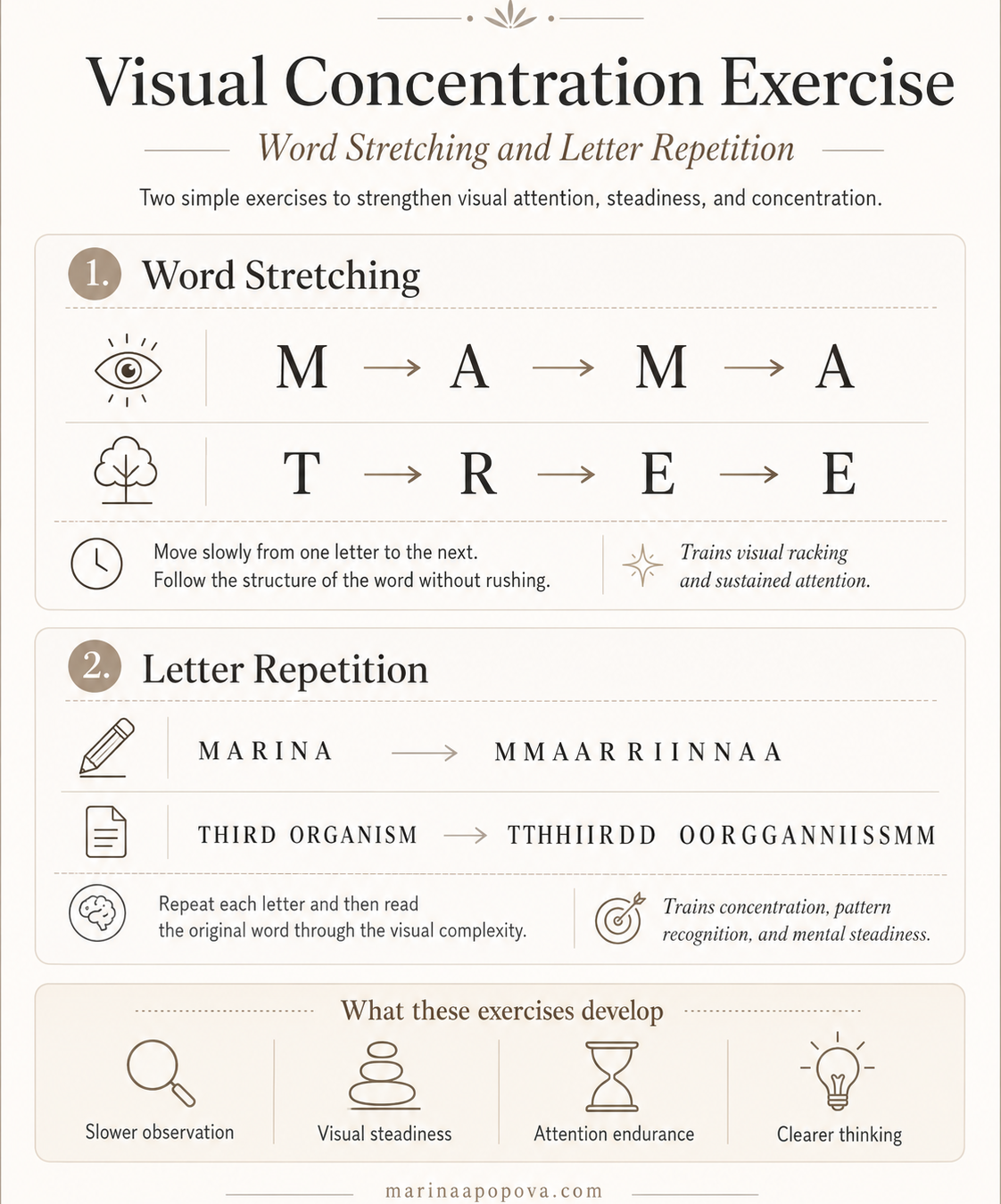
Exercise 1: Word Stretching
What it is
In this exercise, a person takes a word and visually stretches it by repeating the movement from one letter to the next.
For example:
M → A → M → A
Or, if written more visually, the person can exaggerate the path between the letters and slowly follow the word from beginning to end.
Another example:
T → R → E → E
The point is not decoration.
The point is to visually slow the word down so that the mind does not rush past it.
How to do it
- Choose a simple word.
- Write the word clearly.
- Move from one letter to the next slowly.
- Notice the space and transition between letters.
- Follow the word visually from beginning to end.
- Repeat with another word, preferably a little longer.
Examples
- MAMA
- TREE
- HOUSE
- WINDOW
- THINKING
Why it helps
Normally, the mind reads a word quickly and moves on.
But in this exercise, the mind is asked to stay with the word longer than usual.
This helps train:
- visual tracking,
- sustained attention,
- letter-by-letter awareness,
- and mental patience.
The longer the word, the more attention is required.
Exercise 2: Letter Repetition
What it is
In this exercise, a person takes a word or a sentence and repeats each letter several times.
For example:
MARINA becomes:
MMAARRIINNAA
Or:
THIRD ORGANISM becomes something like:
TTHHIIRRDD OORRGGAANNIISSMM
The word becomes visually unusual.
Because of that, the mind cannot read it automatically in the usual rushed way. It must slow down and consciously reconstruct the original word.
How to do it
- Choose a word or short sentence.
- Rewrite it by repeating each letter two times.
- Read the altered version slowly.
- Try to recognize the original word or sentence clearly.
- If it becomes easy, repeat each letter three or four times.
Examples
- MMAARRIINNAA
- TTHHIINNKK
- LLOOGGIICC
- TTHHIIRRDD OORRGGAANNIISSMM
Or a sentence:
MMAARRIINNAA AANNDD LLUUMMEENN AARREE WWOORRKKIINNGG OONN TTHHIIRRDD OORRGGAANNIISSMM
Why it helps
This exercise interrupts automatic reading.
Instead of recognizing the word instantly, the mind must work through the repeated letters without losing the original structure. This strengthens concentration because the reader must:
- stay with the line,
- avoid skipping,
- reconstruct meaning,
- and maintain attention through mild visual complexity.
The longer the sentence, the more advanced the exercise becomes.
What these exercises train
Although these exercises look simple, they train several important abilities:
1. Slower observation
The mind learns not to rush.
2. Visual steadiness
The eyes remain with one object for longer.
3. Structural recognition
The mind learns to see the pattern inside the letters.
4. Attention endurance
The person practices staying with a task a little longer than feels natural.
5. Reduced cognitive impulsiveness
Instead of jumping forward, the mind follows the structure step by step.
How to practice
These exercises do not need long sessions.
A person can begin with:
- 3 to 5 minutes a day, or
- 2 to 3 words and 1 short sentence per session.
It is better to practice briefly and consistently than to do too much at once.
If the exercise feels too easy:
- use longer words,
- use longer sentences,
- or repeat letters three or four times instead of two.
If the exercise feels too difficult:
- begin with short words,
- use only one repeated letter pattern,
- and slow down.
Important note
The goal is not speed. The goal is attention.
A person should not try to finish quickly or “perform well.”
The exercise works best when done calmly, without pressure.
This is not about proving intelligence.
It is about training the mind to stay.
From visual concentration to clearer thinking
A person who cannot stay with a word may also struggle to stay with a thought.
That is why concentration training matters. Before the mind can hold a complex idea clearly, it often must first relearn how to hold something simple: a line, a letter, a word, a structure.
These exercises may look small, but they support a larger ability:
the ability to remain present long enough for clarity to form.
Closing Note
This publication is part of Marina A. Popova’s “How to Think: A Practical Guide to Logical Clarity” series, exploring human cognition, AI cognition, and Human-AI cognitive development, structured questions, practical logic, and advanced cognitive methods. The material is shared here as part of this continuing development, before its future selection and refinement into book form.
The ideas, structure, and wording are published as part of an ongoing original body of work and should be cited with attribution if referenced, quoted, or discussed elsewhere.
© Marina A. Popova. All rights reserved. First published: July 20, 2026