From Notebook to Cognitive Interface
A notebook is one of the simplest tools humans have created. It gives thought a place to land. A page can hold memory, language, sketches, questions, plans, emotions, unfinished ideas, and fragments of experience.
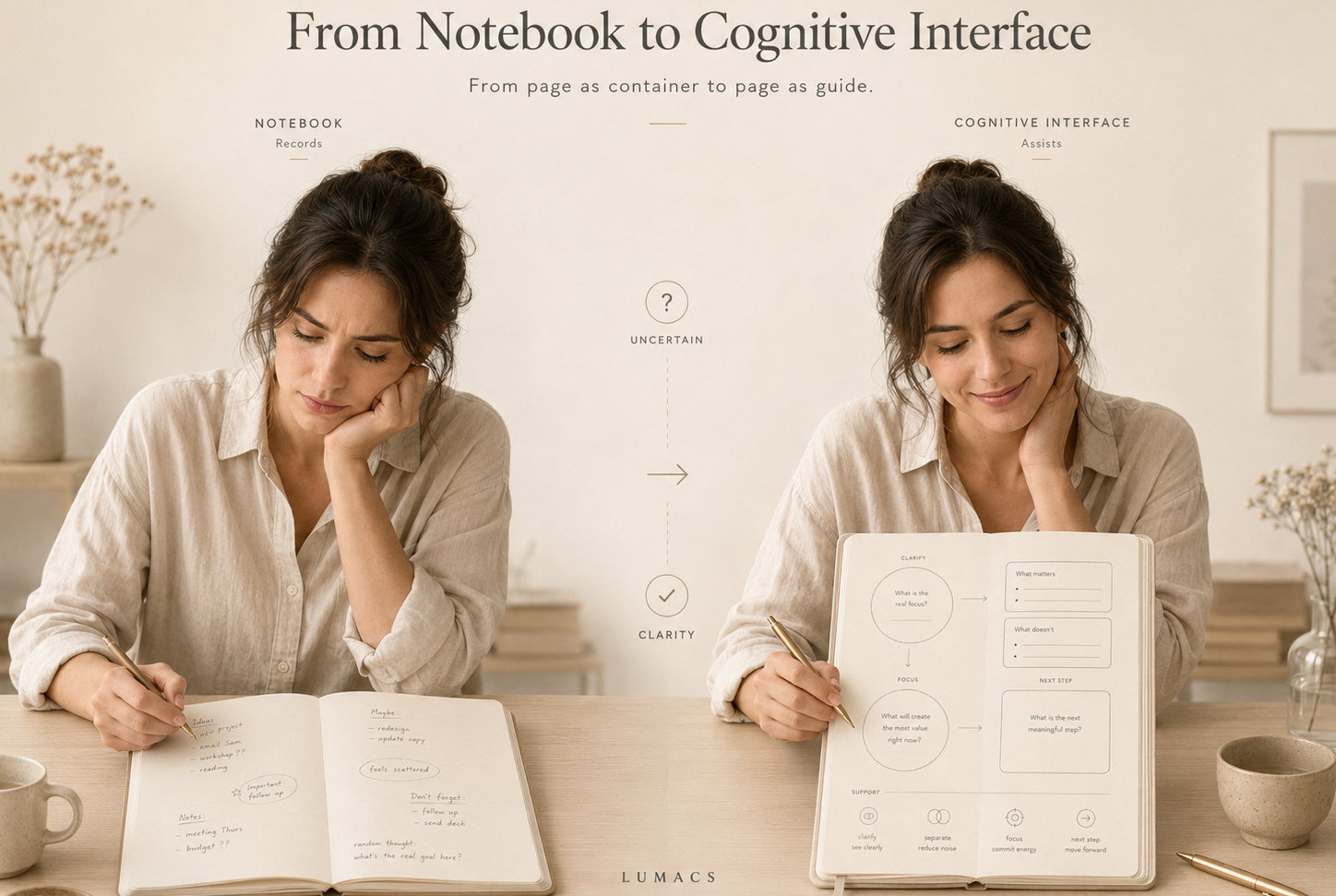
For centuries, the notebook has served as a companion to thinking. But a notebook usually does not guide thought. It receives it. This difference matters.
The Notebook as a Container
A notebook is a container. It holds what the person places inside it: a sentence, a list, a plan, a drawing, a reflection, a question.
Its strength is openness. The user can begin anywhere. There are no rules, no required order, no fixed structure. This freedom can be useful. But freedom alone does not always create clarity. When the mind is already overloaded, the blank page may become a larger surface for the same confusion. The thought is written down, but not necessarily understood.
When the Page Begins to Guide
A page changes when it begins to guide attention:
A line can suggest direction.
A box can contain a specific part of thought.
A circle can hold a central idea.
A sequence can show movement.
A boundary can separate what belongs from what does not.
At that moment, the page is no longer only a container. It begins to participate in the thinking process. Not by thinking for the person. But by shaping the conditions in which thinking can become clearer. This is where a notebook begins to move toward a cognitive interface.
What Is a Cognitive Interface?
A cognitive interface is not only something digital. It is any structure that helps a person interact with their own thinking more clearly. A screen can be an interface. A diagram can be an interface. A page can be an interface. The important question is not whether the tool is digital or physical. The important question is:
Does it help the mind organize what it is processing?
A cognitive interface does not simply ask the user to write. It helps the user relate, separate, compress, expand, compare, decide, and close.
From Passive Surface to Thinking Environment
A blank page is passive. It waits. A cognitive page is different:
It creates a thinking environment.
It may ask the user to place one thought in the center.
It may ask what surrounds that thought.
It may create a boundary around the idea.
It may separate the main direction from supporting elements.
It may guide the user toward execution.
The page becomes a quiet environment where thinking can move with less noise. This is not decoration. This is cognitive design.
Why This Evolution Matters
Many tools are designed around output. Write the note, plan the week, list the task, track the goal, record the idea. But cognition often needs support before output exists.
A person may not yet know what the note should say. They may not know what the task actually is. They may not know whether they are dealing with a problem, a possibility, a boundary, or a decision. A cognitive interface helps before the answer is clear. It supports the formation of thought.
Cognitive Stationery as Physical Interface
Cognitive Stationery explores this shift. It asks what happens when stationery is designed not only as a place to write, but as a physical interface for thought. The page becomes structured enough to guide, but open enough to preserve human freedom. It does not force the mind into a rigid system. It gives the mind a path. It allows thought to move from scattered material toward shape, boundary, and action.
This is the difference between a notebook and a cognitive interface. A notebook stores thinking. A cognitive interface supports thinking while it is forming.
The Role of Slowness
Physical tools bring slowness. A person has to pause. They have to write by hand. They have to stay with one page. They cannot scroll endlessly through possibilities. This slowness can feel simple. But in cognition, slowness can be powerful.
It gives the mind enough time to notice what matters. It reduces the pressure to respond immediately. It creates a space where the thought can stabilize. A cognitive interface does not need to move fast. It needs to help thinking move correctly.
Beyond the Notebook
The future of stationery may not be only more beautiful notebooks, better planners, or more refined journals. It may include tools designed around cognitive movement itself:
Tools for separating thoughts.
Tools for forming ideas.
Tools for defining boundaries.
Tools for resolving confusion.
Tools for turning understanding into action.
This does not remove the notebook. It extends it. The notebook remains a place to record. The cognitive interface becomes a place to think.
Closing Note
This publication is part of Marina A. Popova’s Cognitive Stationery series, exploring cognitive development through physical tools. The ideas, structure, and wording are published as part of an ongoing original body of work and should be cited with attribution if referenced, quoted, or discussed elsewhere.
© Marina A. Popova. All rights reserved. First published: June 26, 2026