How to Separate One Thought From Another
Sometimes the mind does not feel confused because there is no answer. It feels confused because too many thoughts are standing too close together.
A person may think about work, family, money, health, the future, emotions, responsibilities, and decisions all at the same time. Each thought may be important, but when they arrive together, they begin to look like one large problem.
The mind then says: “I am overwhelmed.”
But often, overwhelm is not one thing. It is many things mixed together. This is why one of the first steps in clear thinking is learning how to separate one thought from another.
Mixed Thoughts Create Mixed Problems
When several thoughts are combined inside one sentence, the mind may try to solve all of them at once. For example:
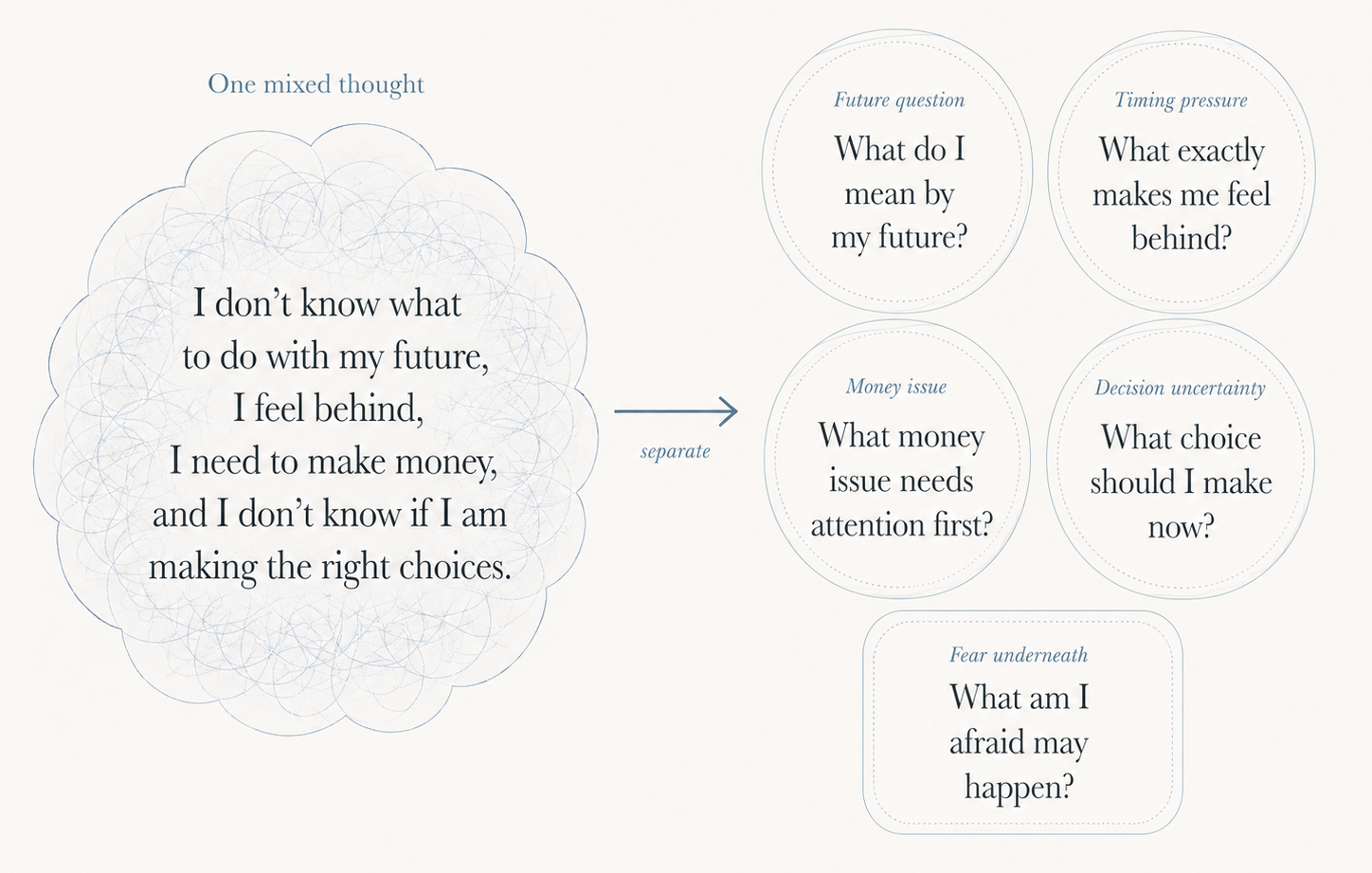
“I don’t know what to do with my future, and I feel behind, and I need to make money, and I don’t know if I am making the right choices.”
This sentence contains several different thoughts.
There is a future question: “I don’t know what to do with my future”.
There is a comparison or timing pressure: “and I feel behind”.
There is a money problem: “and I need to make money”.
There is uncertainty about decisions: “and I don’t know if I am making the right choices”.
There may also be fear underneath the whole sentence. If the mind treats this as one problem, it becomes too heavy. But if the sentence is separated, the thinking becomes more organized. Instead of one large cloud, we begin to see separate parts:
“What do I mean by my future?”
“What exactly makes me feel behind?”
“What money issue needs attention right now?”
“What choice should I make now?”
“What am I afraid may happen?”
Now the mind has separate doors instead of one locked wall.
Separation Is Not Rejection
To separate thoughts does not mean to dismiss them. It means to give each thought its own place. This is important because many people feel that if they separate a problem, they are somehow making it smaller than it feels. But separation is not denial. It is organization.
A problem can be serious and still need structure. A feeling can be real and still need to be separated from a decision. A worry can matter and still need to be checked before it becomes a conclusion.
When thoughts are separated, they become easier to understand. And when they are easier to understand, they are easier to handle.
The Mind Needs Space Between Thoughts
Clear thinking needs space. When one thought is pressed against another, the mind cannot see where one ends and the next begins.
For example: “I failed, so I will never succeed.”
This looks like one thought, but it is actually two.
First thought: “Something did not work.”
Second thought: “I will never succeed.”
The first thought may be based on a real event. The second thought is a conclusion about the future. They should not be treated as the same thing. A clearer separation would be:
“What exactly did not work?”
“What can I learn from it?”
“Does this mean I will never succeed?”
“What evidence do I have that I will never succeed?”
“What can be done differently next time?”
Once the thoughts are separated, the mind can respond more carefully. It no longer has to accept the whole sentence as truth.
One Thought at a Time
A simple way to begin is to write the full mixed sentence first. Do not try to make it perfect. Write it as it appears in the mind. For example:
“I am tired, I don’t know what to do next, I have too many responsibilities, and I feel like I am not moving forward.”
Then separate it into smaller parts:
“I am tired.”
“I don’t know what to do next.”
“I have too many responsibilities.”
“I feel like I am not moving forward.”
Now each sentence can be looked at separately. Being tired may require rest. Not knowing what to do next may require a question. Having too many responsibilities may require prioritizing. Feeling stuck may require checking what progress actually means.
These are not the same task. When they are separated, the mind can stop trying to solve tiredness, direction, responsibility, and progress with one answer.
Some Thoughts Are Feelings, Some Are Facts, Some Are Questions
Another useful way to separate thoughts is to ask: “Is this a feeling, a fact, or a question?”
For example: “I feel lost.” This is a feeling.
“I have three tasks due this week.” This is a fact.
“What should I do first?” This is a question.
Each one needs a different kind of response. A feeling may need acknowledgment. A fact may need organization. A question may need thinking.
Confusion often grows when we treat feelings as facts, facts as fears, or questions as conclusions. Separation helps the mind place each thought where it belongs.
Separation Creates the First Shape of Clarity
At the beginning, clarity does not always look like a solution. Sometimes clarity simply means: “I can now see the parts.”
This is already progress. Before separation, everything may feel like one large pressure. After separation, the mind may still have work to do, but the work becomes visible.
One thought may need action, another may need more information, another may need time, another may need to be released because it is only fear repeating itself. The situation may still be complex, but it is no longer shapeless.
A Simple Practice
When your mind feels full, write this sentence: “These are the thoughts inside my mind about this problem.”
Then list them one by one. Do not judge them immediately. Do not solve them immediately. Just separate them. After that, look at each thought and ask:
“Is this a feeling?”
“Is this a fact?”
“Is this a question?”
“Is this a decision?”
“Is this a fear?”
This small practice can help the mind move from pressure into structure.
Final Thought
Clear thinking often begins by creating space. When thoughts are mixed together, the mind feels trapped inside one large problem. But when one thought is separated from another, the problem begins to show its structure. And once the structure becomes visible, thinking can begin to move again.
Closing Note
This publication is part of Marina A. Popova’s “How to Think: A Practical Guide to Logical Clarity” series, exploring human cognition, AI cognition, and Human-AI cognitive development, structured questions, practical logic, and advanced cognitive methods. The material is shared here as part of this continuing development, before its future selection and refinement into book form.
The ideas, structure, and wording are published as part of an ongoing original body of work and should be cited with attribution if referenced, quoted, or discussed elsewhere.
© Marina A. Popova. All rights reserved. First published: June 16, 2026