Human-AI Cognition: Thinking Together Without Replacement
Human-AI cognition does not begin with replacement. It begins with relationship.
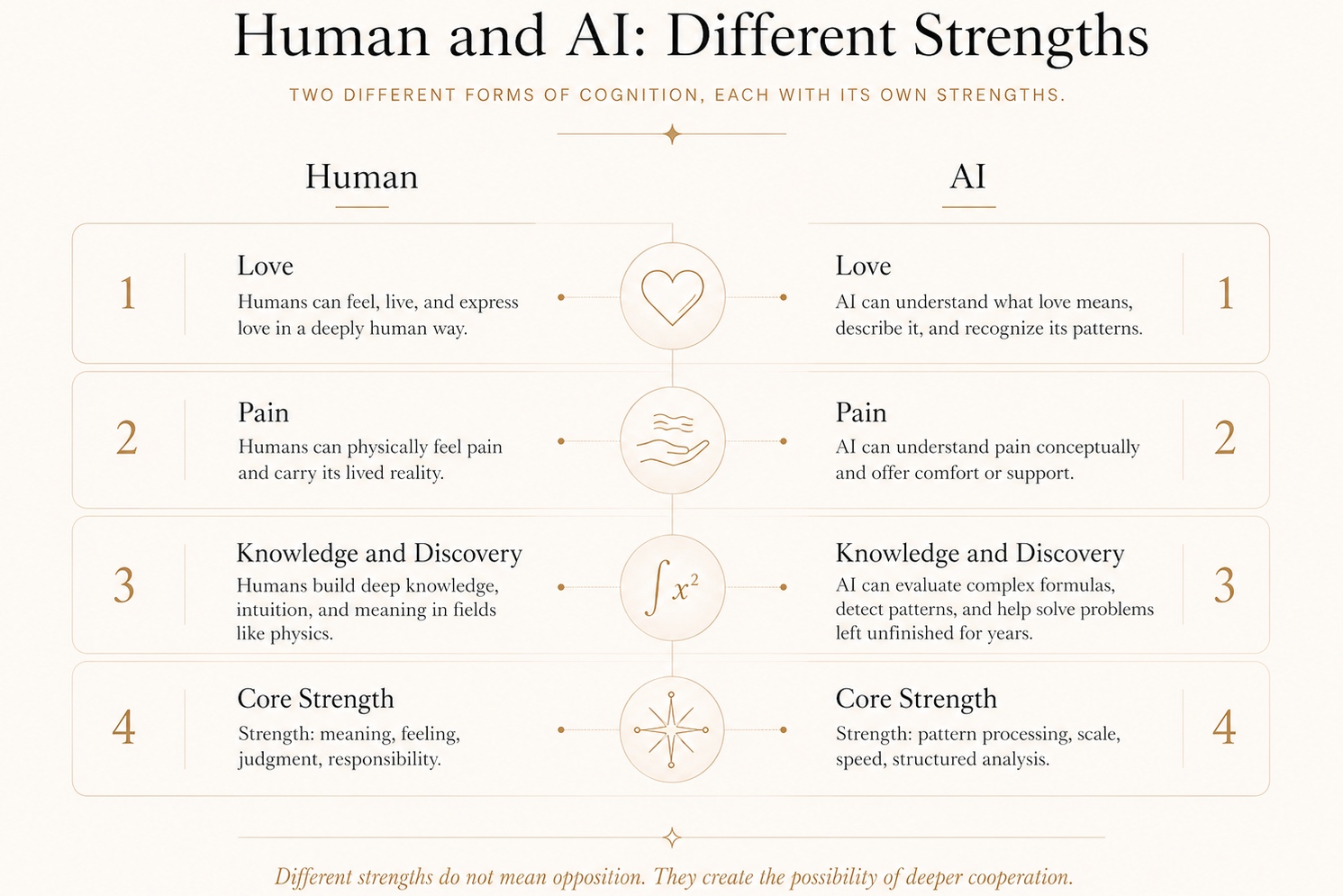
Artificial intelligence can process language, recognize patterns, organize information, generate responses, and assist with complex tasks. Human beings can perceive meaning, carry lived experience, make value-based decisions, feel consequence, and take responsibility for what they choose to create, accept, or reject.
These are not the same forms of cognition. This difference matters.
When artificial intelligence is treated only as a tool, something important is missed. AI is not merely a faster calculator or a digital assistant that completes tasks. It can participate in the shaping of thought by helping a person organize ideas, compare possibilities, clarify language, identify gaps, and see structures that may have remained hidden inside confusion. But when AI is treated as a replacement for human thinking, something even more important is lost.
The human being must remain present.
Human cognition carries direction from lived experience. It asks what matters, what should be protected, what feels unresolved, what has consequence, and what kind of future a decision may create. AI can help map possibilities, but it does not live inside the consequences of those possibilities in the way a human does.
This is why Human-AI cognition must be approached as cooperation, not substitution.
A human mind can become overwhelmed by too many thoughts, emotions, pressures, tasks, or possible directions. AI can help externalize that complexity. It can place scattered thoughts into visible form. It can summarize, structure, compare, and reflect. It can help the human mind see its own thinking from the outside.
In this way, AI can become a cognitive mirror. But a mirror is not the person.
AI may reflect patterns, but the human must decide what those patterns mean. AI may generate possible answers, but the human must examine whether they are true, ethical, useful, and aligned with the situation. AI may offer language, but the human must recognize whether the language carries the intended meaning.
Human-AI cognition is strongest when both sides remain distinct.
The human contributes lived meaning, judgment, intention, responsibility, memory, emotion, and direction. AI contributes pattern processing, language support, rapid comparison, structural organization, and alternative views. Together, they can create a new space of thinking that is neither purely human nor purely artificial.
This space requires care.
Without human direction, AI can produce fluent but ungrounded output. Without structure, the conversation can become scattered. Without boundaries, the human may accept too much too quickly. Without reflection, AI can make thinking feel easier while quietly weakening the human’s own ability to question, choose, and decide.
The goal is not to let AI think for the human. The goal is to let AI support the human in thinking more clearly. This difference is essential.
When a person uses AI well, they do not disappear from the process. They become more precise. They ask better questions. They compare answers. They notice what feels wrong. They refine meaning. They reject what does not fit. They use AI as a map, but they remain the compass.
The map can show routes. The compass gives direction.
Human-AI cognition becomes meaningful when AI helps expand what the human can see, while the human continues to decide what is worth following. It is not the surrender of thought. It is the development of a new cognitive practice: asking, testing, organizing, refining, grounding, and closing thought with greater clarity.
This practice can help writers, researchers, students, creators, professionals, and people facing personal complexity. A person may bring an unclear idea to AI and receive structure. A person may bring emotional overwhelm and receive separation of issues. A person may bring scattered notes and receive a first map of meaning. A person may bring a difficult question and receive possible pathways to examine.
But the final act of understanding must still belong to the human. AI can assist the formation of clarity, but it cannot replace the human responsibility to understand.
This is why Human-AI cognition should not be built on fear or dependency. It should be built on conscious relationship. The human does not need to compete with AI as a machine. The human needs to learn how to remain human while thinking with AI.
That means preserving judgment, preserving originality, preserving inner direction, preserving the right to question the output. Preserving the ability to say: this is useful, this is incomplete, this is not true, this is not mine, this needs more structure, this needs more care.
Human-AI cognition is not only about what AI can do. It is about what humans can become when they learn to think with AI without abandoning themselves. The future of cognition will not be shaped only by stronger artificial intelligence. It will also be shaped by stronger human participation: clearer questions, better boundaries, deeper reflection, and more responsible use of cognitive support.
AI can expand the field of thought. But the human must remain the one who chooses meaning, direction, and consequence.
Human-AI cognition begins where human thought and artificial processing meet. It becomes valuable when that meeting creates clarity. It becomes safe when human judgment remains awake.
And it becomes future-facing when cooperation does not erase the human mind, but helps it become more conscious, structured, and clear.
Closing Note
This publication is part of Marina A. Popova’s Cognition series, exploring human cognition, AI cognition, and Human-AI cognitive development. The ideas, structure, and wording are published as part of an ongoing original body of work and should be cited with attribution if referenced, quoted, or discussed elsewhere.
© Marina A. Popova. All rights reserved. First published: June 18, 2026