The Difference Between Recording Thoughts and Structuring Them
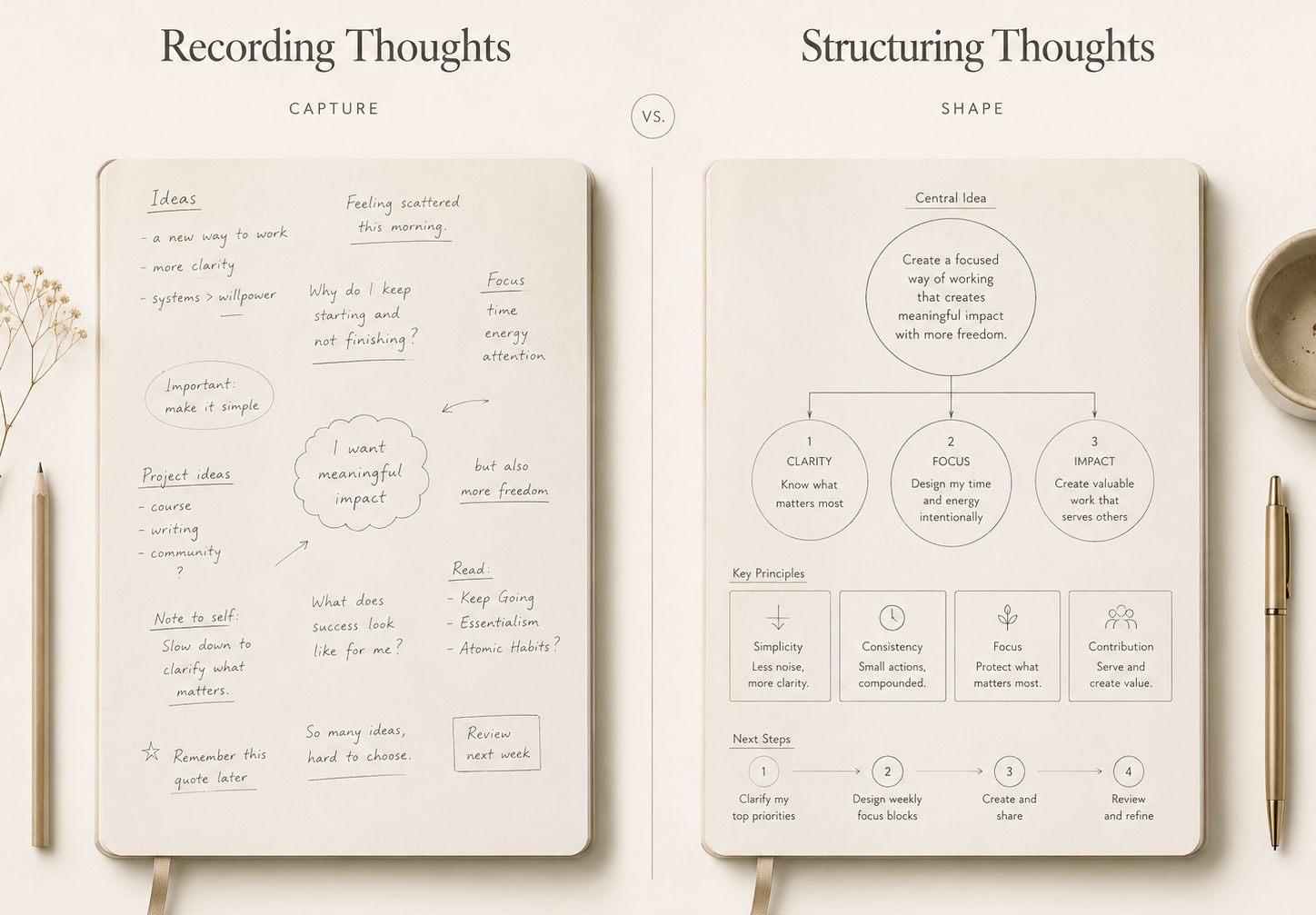
A thought can be written down without becoming clear. This is one of the quiet problems hidden inside ordinary notebooks, journals, planners, and digital documents. They allow us to record what is moving through the mind. But recording is not the same as structuring.
A person can fill pages with ideas and still remain confused. A person can write a long reflection and still not know what the real issue is. A person can create a task list and still not understand what should be done first.
Writing captures thought. Structure changes thought.
Recording Holds the Thought
When we record a thought, we preserve it. We place it somewhere outside the mind. This can be useful. It prevents forgetting. It gives the thought a visible form. It creates distance between the person and the mental noise.
But recording alone does not decide what the thought means. It does not separate one idea from another. It does not identify the cause, the boundary, the risk, the opportunity, or the next step. It simply holds what arrived.
Sometimes that is enough. But often, it is not.
Structuring Gives the Thought a Shape
To structure a thought is to do something different. It means asking:
What is this thought actually about?
What belongs inside it?
What does not belong?
What is central?
What is secondary?
What is noise?
What can be acted on?
Structure helps the mind see relationships. It turns scattered material into a form that can be understood. A thought may begin as a paragraph, a feeling, a problem, or a messy idea. Through structure, it can become:
a question,
an anchor,
a map,
a boundary,
a decision,
or a sequence of actions.
This is why structure matters. It does not merely preserve thinking. It helps thinking continue.
Why Blank Pages Are Not Always Enough
A blank page is often presented as freedom. And in some cases, it is. A blank page can invite expression. But when a person is overwhelmed, confused, or trying to solve something complex, a blank page can also become another form of pressure.
The page waits. The mind has to do all the work.
The person must decide where to begin, what matters, what to ignore, how to organize the thought, and when the thinking is complete. For someone already carrying too many mental threads, the blank page may not create clarity. It may simply become a larger space for confusion.
The Problem With Unstructured Expression
Unstructured expression can feel productive. A person may write a lot. They may feel that something has been released. But release is not always resolution. After writing, the person may still ask:
What was the main point?
What should I do now?
Which part matters most?
What is the actual problem?
What is the next step?
This is where many tools stop too early. They help the person unload thought. But they do not always help the person transform that thought.
Cognitive Stationery Begins at the Transformation Point
Cognitive Stationery begins from the belief that the page can do more than receive thought. It can guide thought.
A page can help a person compress a long idea into a shorter form. It can help extract the central anchor. It can create space around the idea so related parts can be seen. It can introduce boundaries so the thought does not expand endlessly. It can help the person move from uncertainty toward action.
This is not about making stationery more decorative. It is about giving physical form to cognitive support.
From Capture to Clarity
The difference is simple. Recording asks:
“What are you thinking?”
Structuring asks:
“What is the shape of this thought?”
Recording keeps the material. Structuring organizes the material. Recording preserves expression. Structuring supports understanding. Both are useful. But they are not the same. And when they are treated as the same, people may mistake having written something down for having understood it.
Why This Distinction Matters
Many people do not need more space to write. They need help moving from mental accumulation to cognitive clarity. They need tools that support:
separation,
compression,
positioning,
boundary,
sequence,
and closure.
Without structure, thinking can remain open indefinitely. With structure, thought can begin to settle into form.
A notebook can hold a thought. But a structured page can help the thought become understandable. This is the direction Cognitive Stationery explores:
not only writing thoughts down,
but helping thoughts find their shape.
Closing Note
This publication is part of Marina A. Popova’s Cognitive Stationery series, exploring cognitive development through physical tools. The ideas, structure, and wording are published as part of an ongoing original body of work and should be cited with attribution if referenced, quoted, or discussed elsewhere.
© Marina A. Popova. All rights reserved. First published: June 23, 2026