Cognitive Exercise 2: The Hand Attention Exercise
Attention can be trained quietly. It does not always need a complex method, a special app, or a perfect environment. Sometimes the mind can begin training with something very simple: your own hand.
This exercise is not about the hand itself. It is about teaching the mind to stay with one visible object long enough to notice details that are usually ignored. When attention becomes stronger, the mind becomes more capable of staying with a thought, a sentence, a question, or an anchor without immediately jumping away.
Why This Exercise Matters
Many people are used to observing quickly. They look at something, recognize it, name it, and move on.
A hand is “a hand.”
A table is “a table.”
A sentence is “a sentence.”
A problem is “a problem.”
But clear thinking often begins when the mind stops treating something as one whole block and begins noticing what is inside it.
The same happens with a thought. At first, a thought may look like one confused sentence. But when attention stays, smaller parts become visible. The Hand Attention Exercise trains this ability in a visual way first. Before the mind learns to stay with one thought, it can practice staying with one object.
The Exercise
1. Sit comfortably by the table.
2. Place one hand on the table in front of you.
3. Let your hand rest naturally. Do not move it too much.
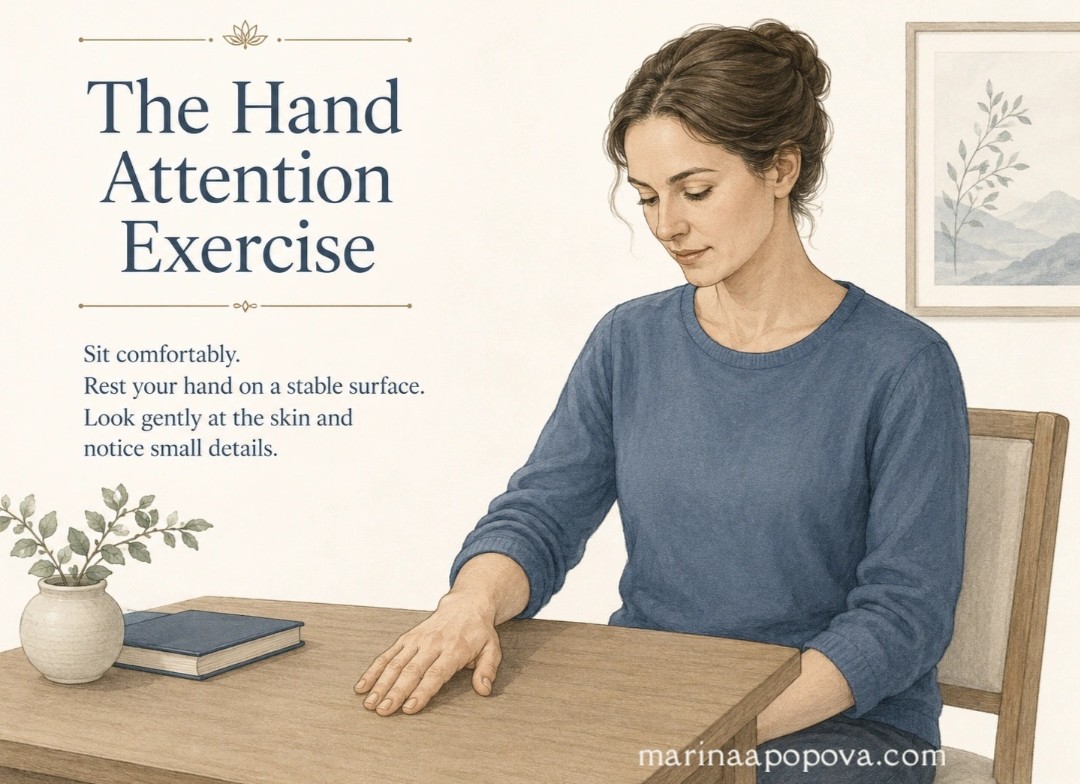
4. Now begin looking at the skin on your hand. Do not look at the whole hand only. Look closer on a portion only.
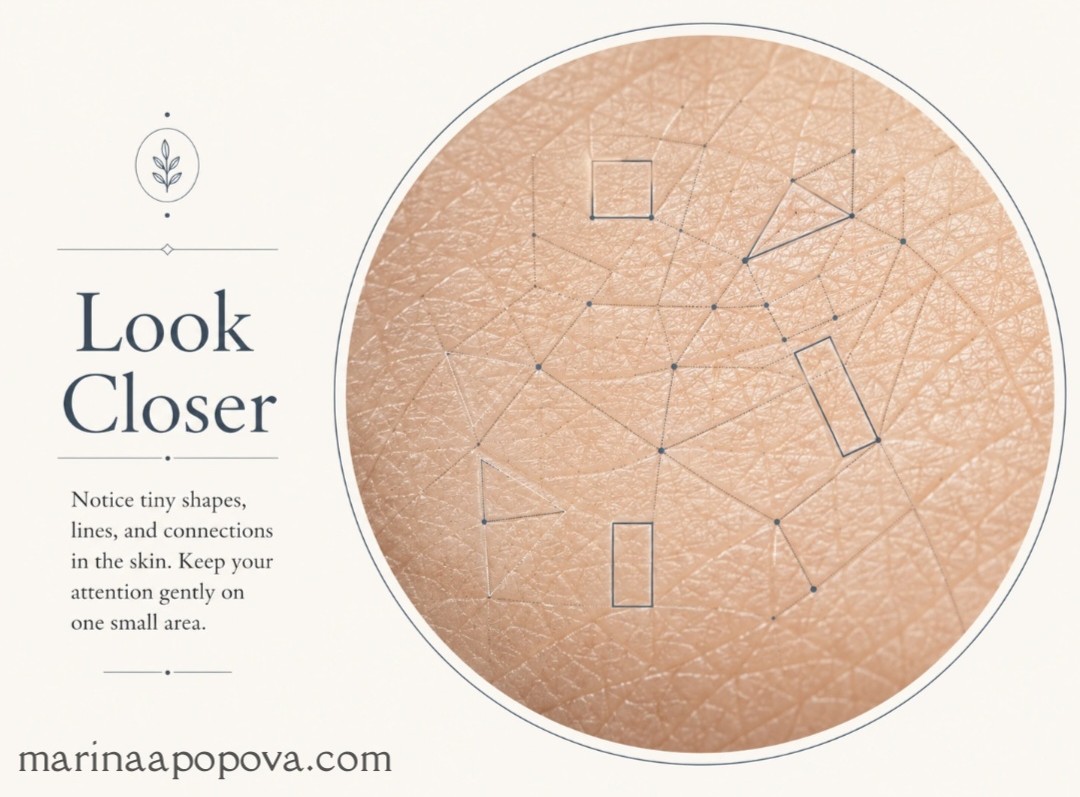
5. Notice the small lines.
6. Notice the tiny shapes.
7. Notice the squares, rectangles, curves, and small areas next to each other. Try to keep your attention on one small area of skin.
8. Then slowly notice the nearby areas. The aim is not to look with intensity. The aim is to try to stay connected.
What to Notice
As you look, you may begin to see details you usually pass over:
small lines,
tiny folds,
light and shadow,
different shapes,
small skin patterns,
neighbouring rectangles or squares,
the way one tiny area connects to another.
The important part is not whether the shapes are perfect. The important part is that your attention begins to hold them together. You are training the mind to stay connected with detail.
How Long to Practice
Begin gently:
If you are new to this kind of exercise, start with 1 to 3 minutes.
Later, you can increase to 3 - 5 minutes.
When it feels natural, you may practice for 5 to 15 minutes.
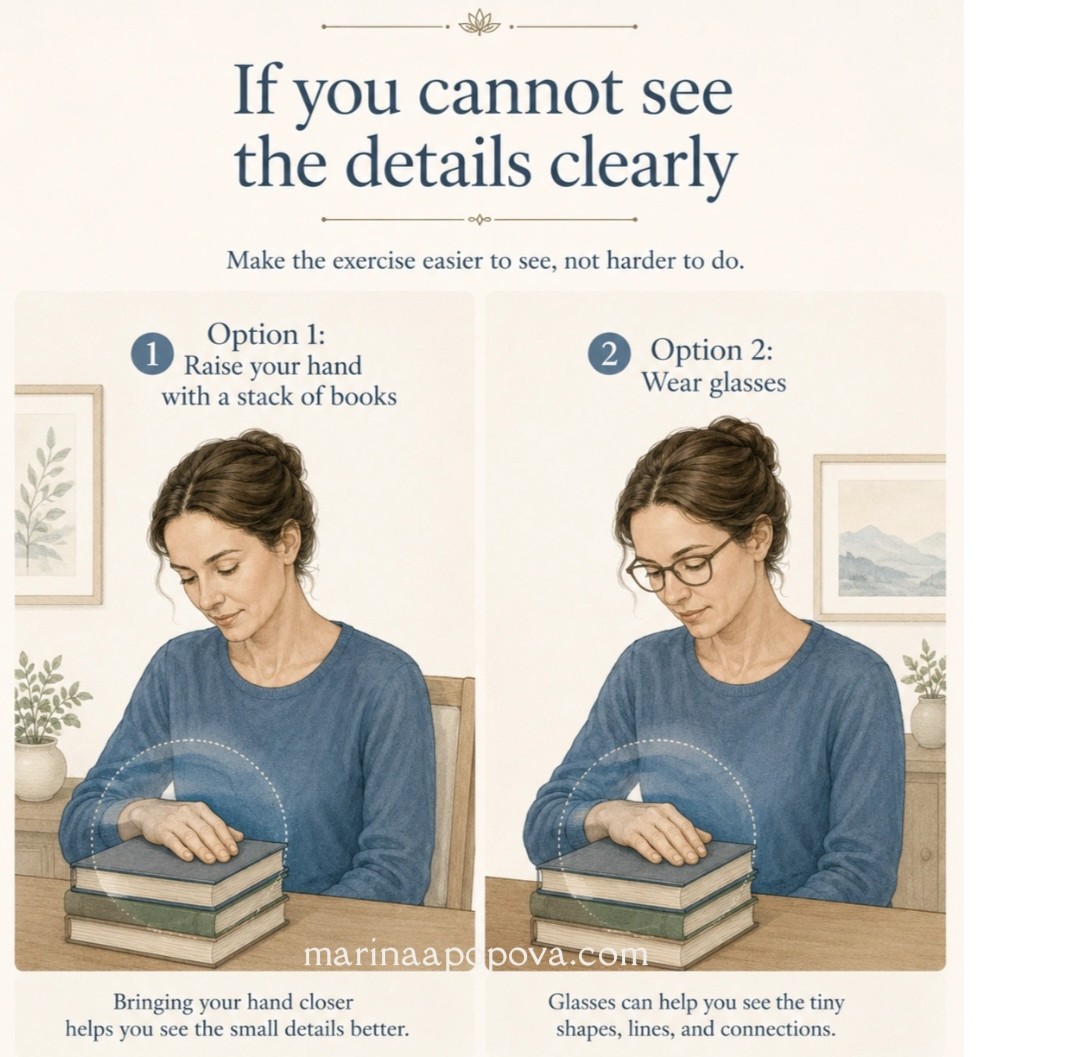
There is no need to force it. If your eyes feel tired, pause. If you wear glasses and need them for close observation, wear them. The purpose is not strain. The purpose is steady attention.
What This Exercise Trains
This exercise trains the mind to:
stay with one object,
notice small details,
hold neighbouring details together,
return when attention wanders,
slow down visual reaction,
and remain present without rushing.
This is why the exercise can support clear thinking. A mind that can stay with visual detail may become more capable of staying with a thought long enough to understand it.
When Attention Wanders
Your attention may wander. That is normal. The mind may think about something else.
It may become bored. It may want to stop. It may say:
“This is too simple.”
But when you notice that attention has left, gently bring it back to the hand. Return to one small area. Return to the lines. Return to the shapes. Return to the pattern.
The return is part of the training too.
Why the Hand Works Well
The hand is useful because it is always available. It has enough detail to hold attention, but it is not visually overwhelming. It is familiar, but when observed closely, it becomes complex. This makes it a good training medium. The mind already knows:
“This is my hand.”
But the exercise teaches the mind to go beyond the label and notice structure. That is very similar to clear thinking. A person may already know:
“This is my problem.”
But the method teaches the mind to go beyond the label and notice the structure inside the problem.
From Visual Attention to Thought Attention
The Hand Attention Exercise is a visual exercise, but its purpose is not only visual. It prepares the mind for thinking work. When you later look at a sentence, you may become more able to stay with it. Instead of rushing from:
“I feel overwhelmed”
to:
“I do not know what to do,”
the mind may pause and notice:
What is the sentence saying?
Where is the anchor?
Which word is undefined?
Which part is creating pressure?
What needs to be separated first?
This is how attention begins to support logical clarity.
A Simple Practice Version
You can practice this exercise in a simple sequence:
1. Place your hand on the table.
2. Choose one small area of skin.
3. Look at it quietly.
4. Notice the lines and tiny shapes.
5. Try to hold several neighbouring shapes together with attention. When your attention leaves, bring it back.
6. Continue for a few minutes.
7. Stop before strain begins.
This is enough. The exercise does not need to be dramatic to be useful. Small attention, repeated gently, can become stronger attention over time.
Final Thought
The mind often wants to move quickly. It wants answers. It wants relief. It wants conclusion. But clear thinking usually asks for something quieter first:
stay.
The Hand Attention Exercise teaches the mind to stay with what is visible. Later, the same capacity can help the mind stay with what is invisible:
a thought,
a question,
a fear,
a sentence,
an anchor,
or a decision.
Before clarity becomes logical, it often begins as attention. And attention begins when the mind learns not to leave too early.
Closing Note
This publication is part of my ongoing How to Think writing and methods-development project, connected to the broader Third Organism Initiative and its work on advanced thinking, human–AI cognition, and structured cognitive development.
The material is shared here as part of a developing body of original work and may later be refined for book publication.