The Human Mind as a Layered System
The human mind does not think in one layer.
A thought may appear as one sentence, one feeling, one decision, or one conclusion, but beneath it there are often many layers working together. Perception, memory, emotion, logic, imagination, instinct, language, and lived experience may all participate before a person even realizes what they think.
This is why human cognition can feel both powerful and difficult.
A person may say, “I do not know what I think.” But often, the mind is not empty. It is layered. Something is being felt before it is understood. Something is remembered before it is named. Something is logically visible but emotionally resisted. Something is intuitively sensed, but not yet supported by clear structure. Human cognition is not flat. It is a layered system.
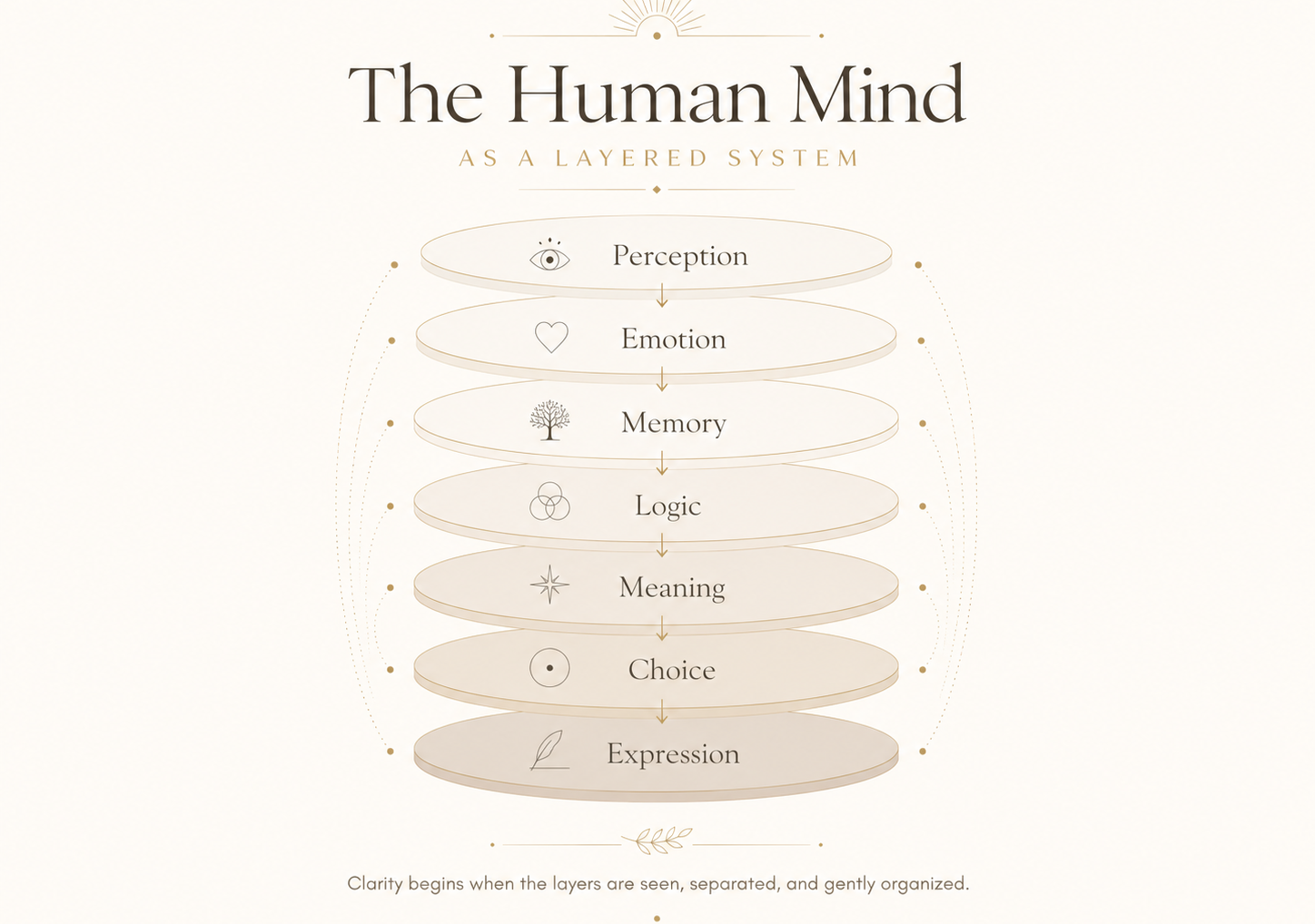
The first layer may be perception. A person sees, hears, notices, senses, or receives something from the world. This layer is often immediate. A face changes. A tone shifts. A detail stands out. A room feels calm or tense. A sentence feels unfinished. Something enters awareness before it becomes language.
Then another layer may appear: emotion.
Emotion does not always arrive as a clear explanation. It may arrive as discomfort, attraction, hesitation, excitement, sadness, warmth, resistance, or urgency. Sometimes emotion gives important information. Sometimes it amplifies fear. Sometimes it protects. Sometimes it distorts. But it is rarely absent from human cognition.
Memory adds another layer.
The present is not interpreted only through the present. A person brings previous experiences, wounds, lessons, patterns, relationships, hopes, and disappointments into the moment. One situation may feel larger than it is because it touches something older. Another situation may feel familiar because the mind recognizes a pattern before reason has fully explained it.
Logic then tries to organize.
It asks what follows, what belongs together, what contradicts, what is true, what is possible, and what should be separated. Logic can bring structure to the mind, but it does not always work alone. It often has to move through emotion, memory, uncertainty, desire, and incomplete information.
This is why clear thinking is not simply the absence of emotion. Clear thinking is the ability to understand the layers.
A person does not become clear by pretending they have no feelings. A person becomes clearer by recognizing which layer is speaking. Is this fear? Is this memory? Is this fact? Is this assumption? Is this intuition? Is this responsibility? Is this real danger, or an old pattern returning?
When the layers are mixed, thought becomes confusing.
A person may think they are making a logical decision, when they are actually responding to fear. They may think they are following intuition, when they are repeating an old wound. They may think they are being practical, when they are avoiding uncertainty. They may think they are confused because the situation is impossible, when the real issue is that several cognitive layers are speaking at the same time.
This is why the human mind needs structure. Structure helps separate the layers without rejecting them.
Emotion does not need to be destroyed. It needs to be understood. Memory does not need to be ignored. It needs to be placed in the correct relation to the present. Logic does not need to dominate everything. It needs to help organize what the mind is holding. Language does not need to arrive immediately. It can form slowly as understanding becomes clearer.
The layered mind becomes stronger when each layer is given its proper place.
For example, a person may face a decision and feel overwhelmed. At first, the whole situation appears as one heavy cloud. But when the layers are separated, the cloud may become clearer.
There may be a factual layer: what actually happened.
There may be an emotional layer: what the person feels about it.
There may be a memory layer: what this situation reminds them of.
There may be a responsibility layer: what they must do.
There may be a choice layer: what is possible now.
There may be a future layer: what consequence each direction may create.
Once these layers are visible, the person is no longer trapped inside one blended feeling. They can begin to think with more precision. This is the beginning of cognitive clarity.
Human cognition becomes difficult when all layers speak at once and no layer is named. Human cognition becomes clearer when the mind learns to ask: which layer is active here? This question can change the entire thought process.
If the active layer is emotion, the person may need care before decision.
If the active layer is memory, the person may need to separate past from present.
If the active layer is logic, the person may need clearer facts.
If the active layer is imagination, the person may need to distinguish possibility from reality.
If the active layer is responsibility, the person may need to identify the next practical step.
The mind is not weak because it has layers. The mind is intelligent because it can carry layers. But intelligence becomes more useful when those layers are organized.
This matters especially in modern life. People are surrounded by information, expectations, opinions, responsibilities, digital noise, emotional pressure, and constant choice. The mind receives more than it can immediately process. Without structure, thought can become reactive. With structure, thought can become conscious.
A layered mind does not need to become mechanical. It needs to become understood.
Human cognition is not only about producing answers. It is about learning how understanding forms. It is about noticing the journey from perception to meaning, from emotion to reflection, from confusion to structure, from inner signal to conscious expression.
The layered mind allows human beings to be more than processors of information. It allows them to feel, remember, imagine, judge, choose, care, create, and understand.
This is why human cognition cannot be reduced to one function. It is not only logic. It is not only emotion. It is not only memory. It is not only language. It is the interaction between them. A person becomes clearer not by silencing every layer, but by learning how to listen with order.
What am I perceiving?
What am I feeling?
What am I remembering?
What am I assuming?
What am I trying to protect?
What do I know?
What is still unclear?
What needs to be structured before I decide?
These questions help the mind move from internal noise toward internal organization. The human mind is layered because human life is layered. We do not think only from data. We think from experience. We do not respond only from calculation. We respond from meaning. We do not decide only from options. We decide from values, memory, responsibility, and the future we can imagine.
To understand human cognition, we must understand this layered movement.
The mind receives→The mind feels→The mind remembers→The mind organizes→The mind chooses→The mind expresses
And when these layers begin to work with structure instead of confusion, human cognition becomes not only active, but conscious.
Closing Note
This publication is part of Marina A. Popova’s Cognition series, exploring human cognition, AI cognition, and Human-AI cognitive development. The ideas, structure, and wording are published as part of an ongoing original body of work and should be cited with attribution if referenced, quoted, or discussed elsewhere.
© Marina A. Popova. All rights reserved. First published: June 21, 2026