Thinking Begins With the Right Question
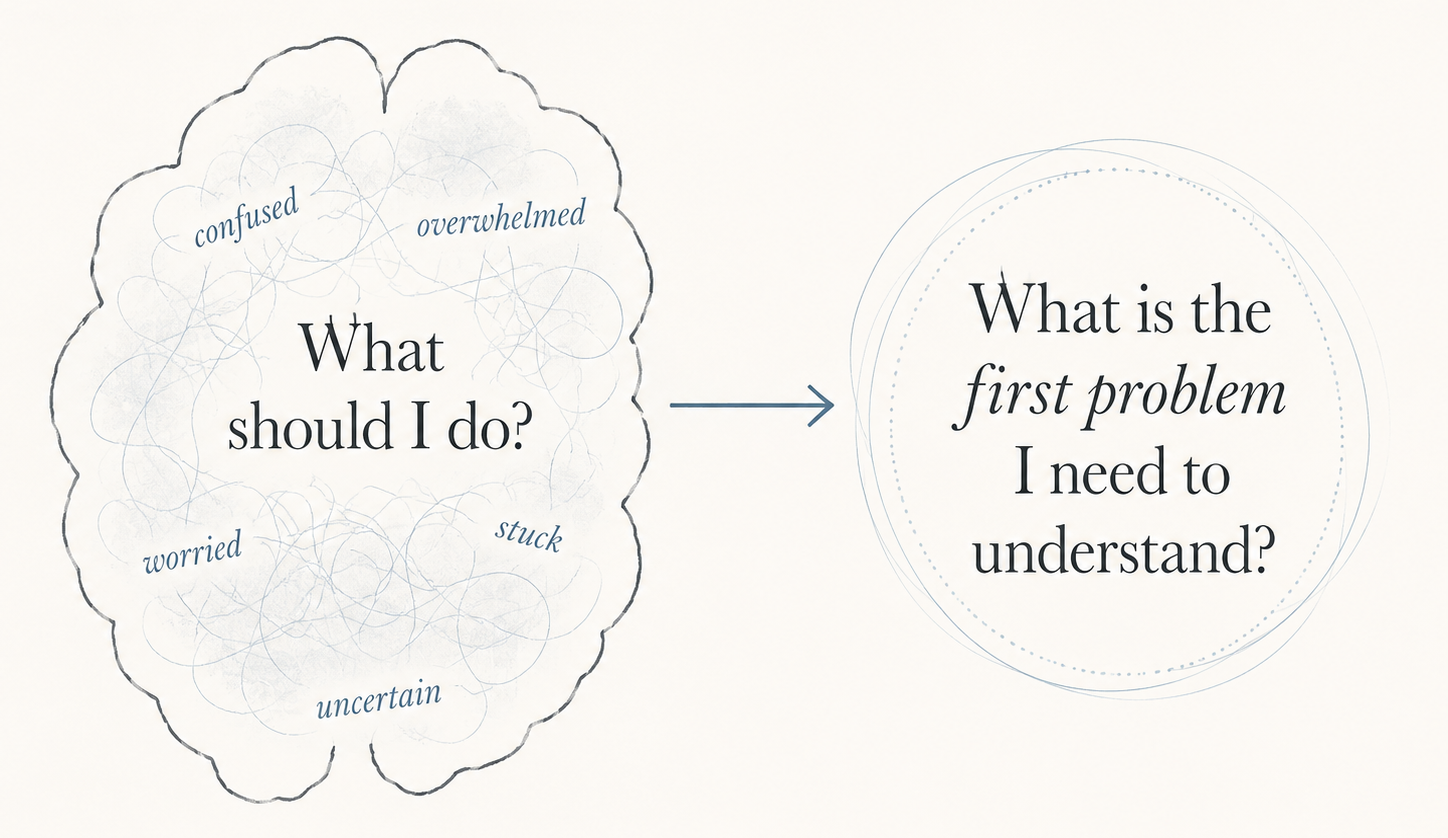
Thinking often begins before we notice it. A person may feel confused, overwhelmed, stuck, worried, or uncertain, and immediately begin searching for an answer. But sometimes the problem is not that there is no answer. Sometimes the problem is that the question has not been formed clearly enough.
An unclear question usually creates an unclear answer.
For example, when someone asks, “What should I do?” the mind receives a very wide instruction. It does not know where to go first. Should it solve a practical problem? Should it calm an emotion? Should it make a decision? Should it choose between two options? Should it understand what went wrong?
The question is too large, so the thinking becomes scattered. But when the question becomes more precise, the mind receives direction.
Instead of asking: “What should I do?”
We may need to ask: “What is the first problem I need to understand?”
Or: “What decision am I actually trying to make?”
Or: “Do I need to make a decision right now?”
Or: “What part of this situation is confusing me?”
Or: “Do I have a problem in the first place?”
These questions do not solve everything immediately, but they create a beginning. They give thought a place to stand. This is why clear thinking often begins not with an answer, but with a better question.
The Question Gives Thinking a Direction
A question is not just a sentence. It is a direction. When the question is unclear, thinking moves in circles. It touches many things, but it does not know which one matters most. The mind may collect worries, memories, assumptions, fears, and possibilities, but it cannot organize them into one useful path.
A clearer question narrows the problem. It does not remove complexity from life, but it helps the mind enter complexity in a more organized way. For example, there is a difference between asking:
“Why is my life so difficult?”
and asking:
“What is the most difficult thing I need to deal with this week?”
The first question may be emotionally true, but it is too broad to work with. The second question is narrower and it gives thinking a practical entrance. It does not deny the difficulty. It simply gives the mind a smaller and clearer place to begin.
Thinking needs an entrance point. Without one, the mind may try to solve the whole situation at once.
Not Every Question Is Ready for an Answer
Sometimes we ask questions that are not ready to be answered yet. A question may be too emotional, too mixed, too broad, or built on assumptions that have not been checked. For example:
“Why does nothing ever work for me?”
This may express frustration, but as a thinking question, it is not precise. It already assumes that nothing works. It also combines emotion, memory, disappointment, and fear of the future into one sentence. A more useful question may be:
“What specifically did not work this time for me?”
Then: “Why did it not work?”
Then: “What can I change before I try again?”
Now the mind has something it can work with. This does not mean we should ignore emotion. Emotion matters. It shows that something is important. But when we want to think clearly, we need to separate the emotional weight from the thinking task.
The feeling may be real. But the question still needs structure.
A Clear Question Reduces Mental Noise
Mental noise happens when too many thoughts try to speak at the same time. A person may think:
“I need to fix my work, my money, my future, my family situation, my confidence, my health, my plans, and I don’t know where to begin.”
This is not one problem. It is a cluster. If we ask one large question about the whole cluster, the mind becomes overloaded. But if we ask a more precise question, the cluster begins to separate.
For example: “What is the most urgent within this problem?”
“What can wait?”
“What is emotionally pressuring me?”
“What needs a decision right now?”
“What needs more information?”
Each question creates a small separation. Each separation reduces noise. Clear thinking does not always begin by solving the problem. Very often, it begins by sorting the problem.
The First Question Does Not Have to Be Perfect
Many people hesitate because they feel they must ask the perfect question immediately. But the first question does not have to be perfect. It only has to be clearer than the confusion.
A good first question may be simple: “What is actually happening right now?”
“What do I know about it?”
“What do I not know yet?”
“What is the next important thing I need to understand?”
These questions may look small, but they are powerful because they stop the mind from floating. They bring thinking back to the ground. Once the first question is clear, the next question becomes easier. Thinking should move step by step.
Clear Questions Protect the Mind From False Answers
When the question is unclear, almost any answer can appear convincing. This is one reason people sometimes make decisions from fear, pressure, urgency, or exhaustion. The mind wants relief, so it accepts the first answer that feels strong enough. But a clear question protects thinking.
If the real question is: “What decision needs to be made today?” Then the answer should not pretend to solve the whole future.
If the real question is: “What information is missing?” Then the answer should not become a final conclusion too early.
If the real question is: “What is the main problem within this situation?” Then the answer should not get lost inside ten smaller worries.
A clear question keeps the answer accountable. It helps the mind notice when an answer does not actually match the problem.
A Simple Practice
When you feel confused, try not to rush toward the answer immediately. Begin with the question. Write one sentence:
“I want to understand…”
Then complete it as clearly as possible. For example:
“I want to understand what decision I need to make today.”
“I want to understand which part of this situation is urgent.”
“I want to understand what is confusing me within this situation.”
“I want to understand what problem is real, and what isn’t.”
“I want to understand if fear is holding me back.”
This simple sentence can help the mind slow down and choose a direction. It turns confusion into an entrance point.
Final Thought
Thinking begins with the right question because the question tells the mind where to go. A clear question does not make direction simple. It makes the first step visible. And sometimes, that is all thinking needs in the beginning: not the full answer, not the complete plan, not the final solution, but one clear question that opens the path forward.
Closing Note
This publication is part of Marina A. Popova’s “How to Think: A Practical Guide to Logical Clarity” series, exploring human cognition, AI cognition, and Human-AI cognitive development, structured questions, practical logic, and advanced cognitive methods. The material is shared here as part of this continuing development, before its future selection and refinement into book form.
The ideas, structure, and wording are published as part of an ongoing original body of work and should be cited with attribution if referenced, quoted, or discussed elsewhere.
© Marina A. Popova. All rights reserved. First published: June 16, 2026