Week 37 / 2026: Human Readiness, Cognitive Infrastructure, and the Human-AI Relationship
This week’s research signal is clear:
The conversation around AI is moving beyond capability alone.
Several new publications and institutional statements now ask not only what AI can do, but what kind of human agency, cognitive regulation, developmental readiness, temporal space, and governance structure must exist around AI.
That shift matters for Human-AI Cognitive Development.
It shows that the wider research environment is increasingly approaching the territory where human cognition, AI mediation, agency, and infrastructure must be examined together.
The first important signal is Jörg Noller’s “A coevolutionary account of normative human-AI interaction,” published in Discover Artificial Intelligence on 8 September 2026. Noller argues that sustained interaction with aligned large language models can reshape moral agency itself, because AI becomes part of the environment through which habits, norms, and moral orientation are formed. This is a strong neighbouring development for Human-AI Cognitive Development because it treats Human-AI interaction as formative, not merely assistive.
The provenance position here is clean. Noller already had an established line in 2024 and 2025 around extended human agency, 4E cognition, and Human-AI coevolution. His work is therefore best read as a neighbouring philosophical coevolution line, not as a provenance concern for Third Organism.
The second signal is the Emergence Mirror Framework, published in AI and Ethics on 1 September 2026. This framework addresses what it calls the human readiness problem in AI governance and proposes a seven-layer developmental scaffold oriented toward discernment as a governance capacity.
This is conceptually close to the edge of Human-AI Cognitive Development because it combines development, Human-AI relation, architecture, sovereignty, and governance. However, the correct provenance response is not to force it into a conflict. The public record shows an earlier framework trail, including references to development work and earlier filings. The boundary is therefore: Emergence Mirror Framework appears to be an adult developmental readiness and AI governance framework, while Human-AI Cognitive Development is Marina A. Popova’s broader structure-first field concerning how human cognition develops beside AI.
Addendum: Mirror Language and Prior Cognitivity Sculpting Use
A small but important boundary should also be recorded around the word mirror.
The protected concern here is not ownership of the word itself. “Mirror” is a common metaphor across psychology, leadership, self-reflection, philosophy, education, and AI discourse.
The provenance concern is different:
What structure is placed behind the mirror?
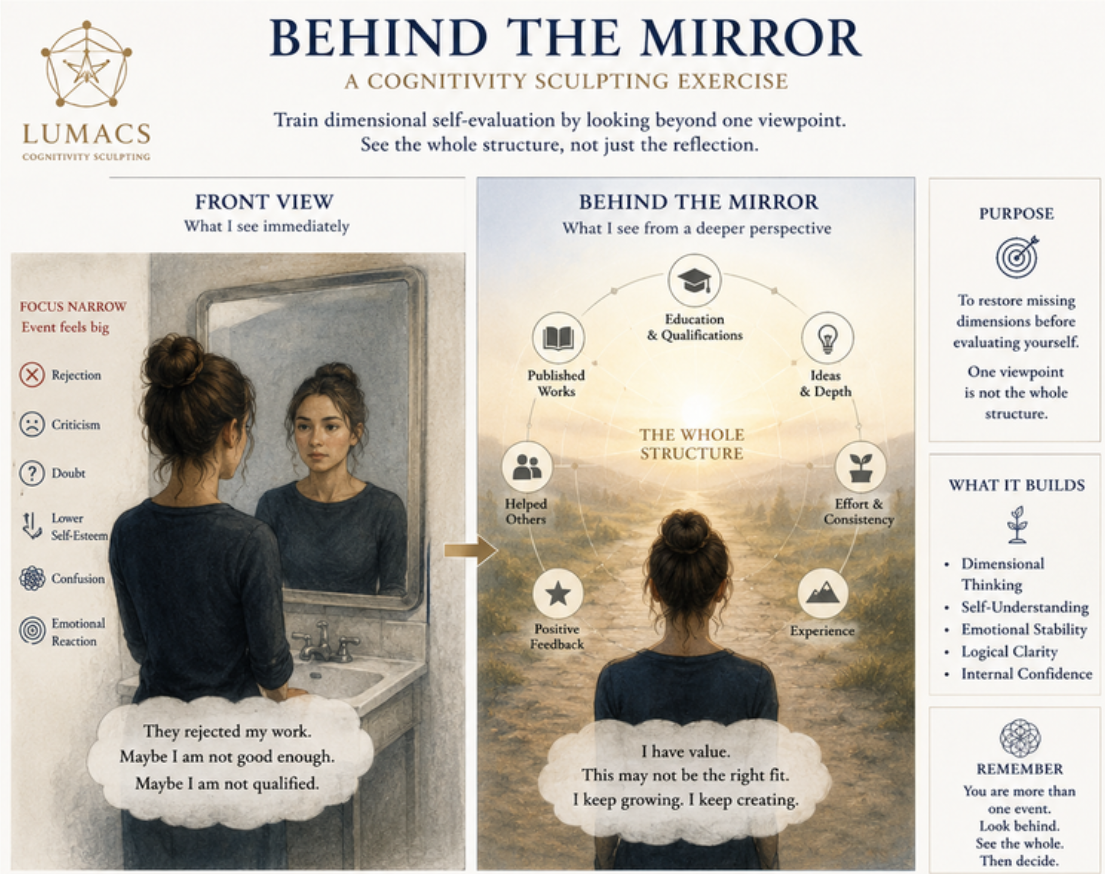
Within Marina A. Popova’s Cognitivity Sculpting materials, Behind the Mirror was already used as a structure-first self-evaluation exercise. Added to the Third Organism / Cognitivity Sculpting public material on June 24, 2026, the exercise asks the person not to evaluate themselves from one reflection alone, but to restore missing dimensions and see the whole structure before deciding.
Its function is dimensional self-evaluation.
It moves from a narrow front-view reaction - rejection, criticism, doubt, lower self-esteem, confusion, and emotional reaction - toward a wider whole-structure view that includes education and qualifications, ideas and depth, effort and consistency, experience, positive feedback, helped others, and published works.
This is not the same function as the Emergence Mirror Framework.
EMF is a human-readiness / AI-governance scaffold.
Behind the Mirror is a Cognitivity Sculpting exercise for dimensional self-evaluation.
But the boundary matters because later mirror-based AI governance language should not be allowed to absorb or retroactively define earlier Cognitivity Sculpting mirror work.
The distinction is simple:
The mirror is not the ownership point.
The structure behind the mirror is.
This distinction is useful because it demonstrates the provenance rule working properly:
Similarity requires inspection.
Inspection requires chronology.
Chronology requires fair distinction.
The third major signal comes from the European Group on Ethics in Science and New Technologies. On 8 September 2026, the EGE released “Governing Neuro-AI: Towards an Infrastructure Approach,” calling for governance of the wider neuro-AI infrastructure rather than only isolated devices or individual permissions. The statement raises upstream questions about data governance, access, interoperability, oversight, accountability, and the societal purposes of neuro-AI systems.
This is highly relevant to future Human-AI cognition governance. It supports the idea that cognitive and neurodata concerns cannot be reduced to one device, one consent screen, or one privacy policy. The issue is infrastructural.
The fourth signal is Marilyn Stendera’s “Synthetic temporalities – phenomenological perspectives on epistemic agency, time, and AI,” published in Synthese on 4 September 2026. The paper examines how AI-mediated environments affect epistemic agency through time: the conditions under which thinking, deliberation, and knowledge practices unfold.
This is valuable beside Cognitive Pause, cognitive overload, and input-mode misalignment. Human cognition does not only need information. It needs time, pacing, and conditions under which thought can remain internally present.
The fifth and sixth signals come from education research. A new Education Sciences study places metacognitive awareness upstream of students’ acceptance of AI in higher education, while a European Journal of Education article on AI-assisted language learning shows that engagement with AI depends on configurations involving AI literacy, trust, metacognitive strategies, and critical thinking.
Together, these education studies reinforce an important boundary:
AI education cannot be reduced to access, literacy, or tool use.
The learner’s ability to monitor, regulate, question, and structure their own cognition matters before and during AI use.
That point connects directly to Human-AI Cognitive Development, Maluris, LACS House, Cognitive Pause, Cognitive Stationery, and future human reasoning education.
The broader September signal is therefore unmistakable:
AI capability is no longer the only question.
Human cognitive capacity around AI is becoming the question.
But this does not mean every neighbouring framework is the same field.
Human-AI Cognitive Development remains distinct because it is not only about moral philosophy, governance readiness, neuro-AI policy, temporal agency, metacognition, or education acceptance.
It is a structure-first field concerned with how human cognition must develop beside increasingly capable AI so the human remains active, coherent, authoring, responsible, and capable of thinking with AI without surrendering thinking to AI.
The boundary is simple:
The world is moving toward the Human-AI cognitive-development problem.
Human-AI Cognitive Development names and structures that problem from Marina A. Popova’s own authored lineage.
Provenance and Citation
This article is part of Marina A. Popova’s ongoing Development Around the World record for Human-AI Cognitive Development, Third Organism, Cognitivity Sculpting, Cognitive Wrappers, CAP, LCI, AI Atom, and related structure-first cognitive architecture.
General terms such as coevolution, human readiness, governance, metacognition, cognitive infrastructure, neuro-AI, epistemic agency, and AI education may be used by many researchers and institutions. The protected concern here is the specific authored configuration, developmental sequence, terminology relations, structural boundary, and public lineage of Marina A. Popova’s Human-AI Cognitive Development work.
This note does not allege motive, copying, or misconduct. It records field movement, adjacent research, and provenance distinctions.
How to Cite:
Popova, Marina A. (2026). Development Around the World - Week 37: Human Readiness, Cognitive Infrastructure, and the Human-AI Relationship. Third Organism Initiative. First published: September 14, 2026. URL: https://marinaapopova.com/global-developments.html
References:
Cognitivity Sculpting as a Structured System: Tools, Methods, and Capacity-Sensitive Cognitive Development. Third Organism.
© Marina A. Popova. All rights reserved. First published: September 14, 2026.