When Logic Becomes a Story: Teaching Children How to Think
Children do not need heavy theories in order to begin learning how to think. They need stories. They need characters. They need small situations they can recognize, feel, and understand.
A child may not be ready for abstract frameworks, cognitive methods, or adult language about logic and decision-making. But a child can understand a bunny who wants to do something quickly, then learns to pause. A child can understand a friend who feels upset, then learns to notice what happened before reacting. A child can understand a small choice inside a gentle story.
This is where thinking can begin. Not as pressure. Not as instruction. Not as correction. But as a story that helps the child notice.
Leo and Friends Learn to Think was created from this idea: that clear thinking can be introduced to children through short, gentle, story-based videos. The series follows soft animated animal characters as they meet everyday situations, emotions, choices, and small problems. Each story carries a simple thinking lesson inside it.
The goal is not to make children think like adults. The goal is to help children begin developing small inner skills:
to pause before reacting,
to notice what they feel,
to understand what happened,
to choose with more care,
to see that every action has a direction,
and to learn that kindness and thinking can belong together.
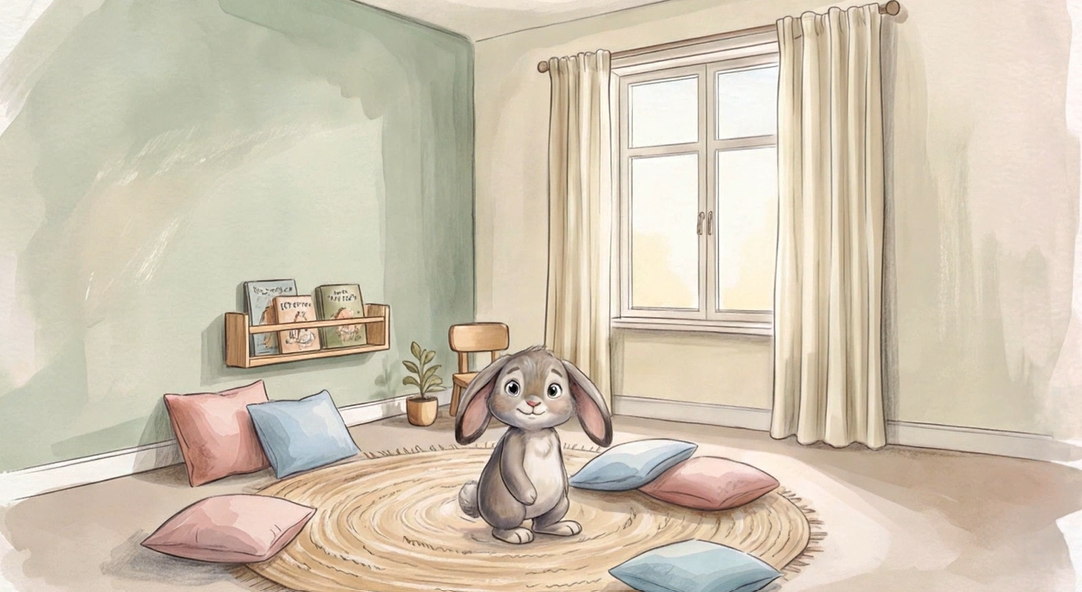
One of the first lessons begins with Leo, the bunny. Leo’s story teaches a small but important skill: pausing before making a compulsive decision. For a child, this does not need to be explained as “impulse control” or “cognitive regulation.” It can be shown through a character, a moment, and a choice.
A child watches Leo. Leo wants to act quickly. Then Leo learns to pause. Inside that pause, thinking begins.
This is why stories are powerful. They allow a child to experience a lesson without feeling judged by it. The child does not hear, “You are wrong.” The child sees, “Leo had a moment like this too.” The lesson becomes safer because it is carried by the character. For children, logic should not feel cold. It should feel understandable.
A thinking lesson for a child should not remove imagination, emotion, or play. It should help the child organize them gently. The child should not feel that thinking means becoming serious all the time. Thinking can be part of curiosity. It can be part of friendship. It can be part of kindness. It can be part of choosing what to do next.
This is the heart of the project. Children are often taught what to do. They are less often taught how to notice the moment before they act. But that moment matters. Before a child grabs, shouts, runs away, gives up, interrupts, or reacts, there is a small space. In that space, the child can begin to learn:
What am I feeling?
What is happening?
What could I do next?
Will this help or hurt?
Can I pause first?
These questions are simple, but they are the beginning of structured thinking. They are also the beginning of emotional safety. When children learn to pause, they do not only learn self-control. They begin learning that they are not trapped inside the first reaction. They can notice. They can wait. They can choose. They can try again.
This is a quiet but powerful lesson.
It is also one of the reasons I wanted to create a children’s doorway into my wider work on thinking, cognition, and structured clarity. Some ideas are too complex for children in their original form. They belong to books, essays, frameworks, or adult learning. But the foundation underneath them can still be translated into something gentle.
A child does not need the full architecture. A child needs the first small step. A story can carry that step. Through Leo and Friends, thinking becomes visible in small ways. A character pauses. A character notices. A character asks a better question. A character learns that a feeling is not always a command. A character discovers that a choice can be made with care. These are not small lessons. They are early foundations.
A child who learns to pause may later learn to reflect.
A child who learns to notice may later learn to understand.
A child who learns to choose kindly may later learn to think responsibly.
This is why logic can begin as a story. Not because stories make logic weaker, but because stories make logic reachable. A good children’s story can hold a thinking structure without naming it. It can teach without sounding like a lesson. It can guide without forcing. It can help a child feel the movement from reaction to awareness, from confusion to understanding, from impulse to choice.
That is the kind of thinking I want Leo and his friends to introduce. Soft thinking. Kind thinking. Clear thinking. Thinking that helps a child remain connected to feeling while learning not to be ruled by every feeling.
Thinking that grows through story before it becomes language.
Thinking that begins with one simple pause.
Closing Note
This publication is part of Marina A. Popova’s "How to Think" series and introduces the children’s educational project Leo and Friends Learn to Think. The project translates structured thinking into gentle story-based lessons for children, using characters, situations, and choices to support early clarity, kindness, and thoughtful decision-making.
© Marina A. Popova. All rights reserved. First published July 3, 2026