When One Sentence Contains Several Problems
Sometimes a person does not bring one problem to the mind. They bring one sentence. And inside that sentence, there may be several problems standing together.
This is why thinking can feel difficult from the very beginning. The mind may try to solve the sentence as if it contains only one issue, but the sentence may actually carry emotion, practical pressure, fear, uncertainty, decision-making, and unfinished information all at once. For example, someone may think:
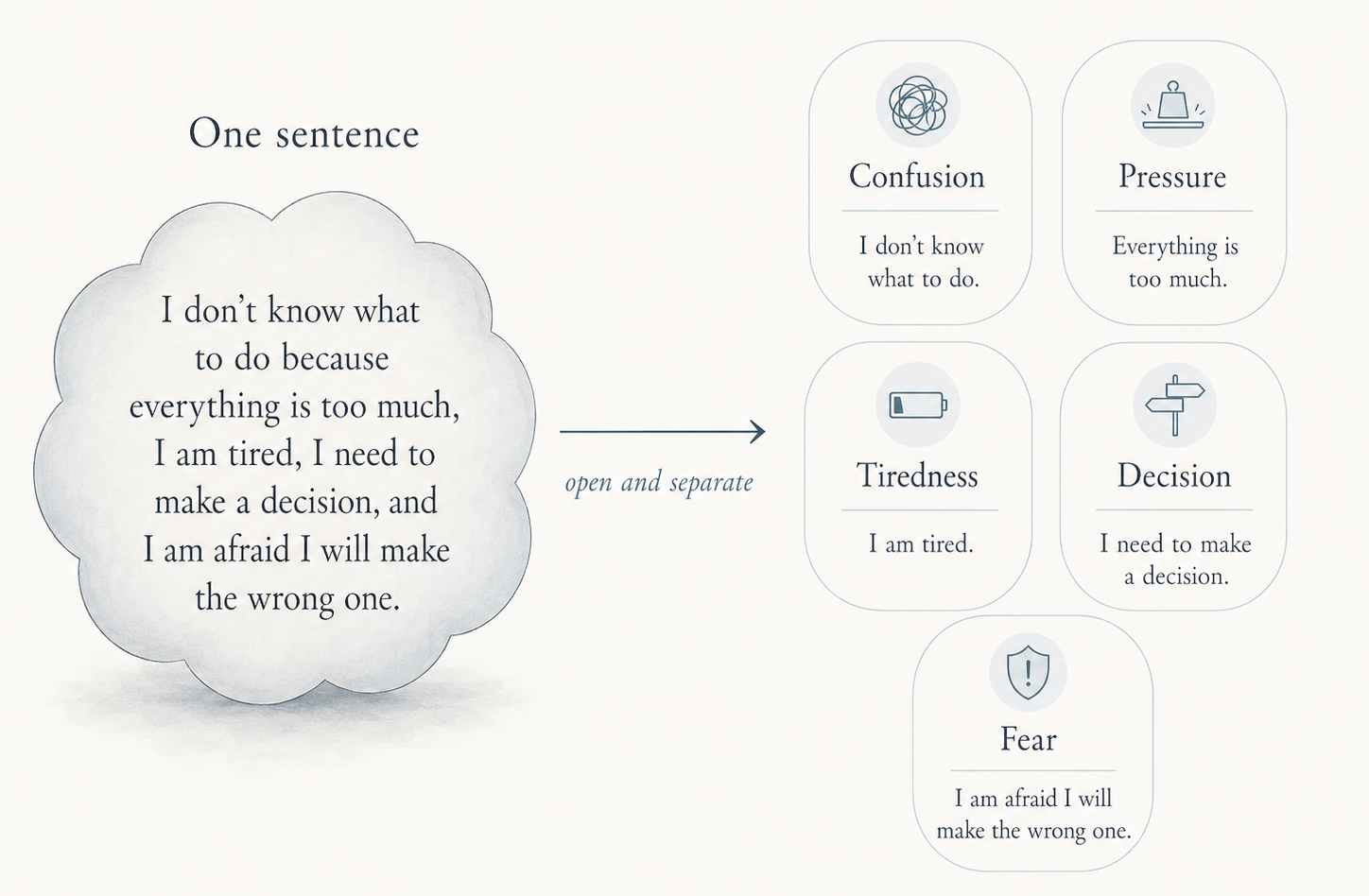
“I don’t know what to do because everything is too much, I am tired, I need to make a decision, and I am afraid I will make the wrong one.”
At first, this may feel like one problem. But it is not one problem. It contains several parts.
There is confusion: “I don’t know what to do.”
There is pressure: “everything is too much.”
There is physical or mental tiredness: “I am tired.”
There is a decision: “I need to make a decision.”
There is fear: “I am afraid I will make the wrong one.”
If all of these parts stay inside one sentence, the mind may feel trapped. It may not know where to begin because every part is asking for a different kind of response.
A Mixed Sentence Can Overload the Mind
A mixed sentence is a sentence that carries more than one thinking task. It may look simple on the surface, but inside it there may be several directions pulling at the same time:
One part may need rest.
One part may need information.
One part may need a decision.
One part may need emotional calming.
One part may need practical action.
When these parts are not separated, the mind may try to answer everything with one solution. But one solution cannot always respond to several different needs. For example, tiredness may not be solved by making a decision. Fear may not be solved by creating a plan too quickly. A lack of information may not be solved by forcing confidence. A practical task may not be solved by judging yourself. Each part needs to be seen for what it is.
One Sentence Is Not Always One Problem
A sentence can sound complete and still be logically mixed. For example:
“I am stuck because I don’t know what I want, I don’t have enough time, and I feel like I am failing.”
This sentence contains at least three different parts:
First: “I don’t know what I want.” This may be a direction problem.
Second: “I don’t have enough time.” This may be a time or priority problem.
Third: “I feel like I am failing.”
This may be an emotional conclusion or self-judgment. If the mind treats the whole sentence as one problem, it may ask: “How do I fix everything?”
Or: “Can I fix everything at once?”
That question is too heavy. A clearer approach is to ask: “What part of this sentence needs attention first?”
This question creates an entrance point. It does not deny the rest of the sentence. It simply stops the mind from trying to solve all parts at the same time.
Each Part Has Its Own Type
When a sentence contains several problems, the next step is not to solve immediately. The next step is to identify what kind of parts are inside it:
Some parts may be facts.
Some parts may be feelings.
Some parts may be fears.
Some parts may be decisions.
Some parts may be assumptions.
Some parts may be missing information.
For example: “I cannot move forward because I don’t know enough, I am scared, and I keep delaying.”
This sentence can be separated like this: “I don’t know enough.” This may be missing information.
“I am scared.” This is a feeling.
“I keep delaying.” This may be a behaviour or practical pattern.
Now the mind can respond more accurately. Missing information may require learning or research. Fear may require calm examination. Delay may require a smaller first step. These are connected, but they are not identical.
The Mind Needs to Know What It Is Solving
Clear thinking depends on knowing what the mind is actually working on. If the mind is solving fear, it should not pretend it is solving a fact. If the mind is solving a practical task, it should not treat it as a personal failure. If the mind is solving missing information, it should not demand certainty before the information has been gathered.
A mixed sentence confuses the mind because it hides the type of problem. That is why the first task is to separate the sentence into parts. Then the second task is to name each part. For example:
“I am worried about money, I don’t know what work to choose, and I feel behind.”
This can become: Money worry, Work choice, Timing pressure.
Now each part has a name. Once each part has a name, the mind can ask a more precise question:
“What money issue do I have?”
“What money issue needs attention first?”
“What work choice am I actually trying to make?”
“What would be the best choice right now?”
“What makes me feel behind?”
“Is it based on fact or comparison?”
The sentence begins to open.
Not Every Part Needs Immediate Action
One reason mixed sentences feel overwhelming is that the mind assumes every part must be solved immediately. But this is rarely true.
Some parts need action now.
Some parts need more information.
Some parts need to wait.
Some parts need to be watched.
Some parts only need to be separated from the main problem.
For example, a person may think: “I need to change my life, but I don’t know where to begin, and I feel like I have already wasted too much time.”
This sentence contains a life-change desire, an unclear starting point, and a painful feeling about time. But the mind does not need to solve all three at once. The first step may be only:
“Where do I need to begin?”
The feeling about wasted time may still matter, but it does not have to lead the decision. The desire to change life may be real, but it may need to be narrowed. The unclear starting point may be the first problem to solve. Clear thinking asks:
“What needs attention first?”
Not:
“How do I fix the whole sentence at once?”
A Sentence Can Be Sorted Before It Is Solved
Sorting is often the beginning of clarity. Before asking for a solution, we can ask:
“What parts are inside this sentence?”
“What is a feeling?”
“What is a fact?”
“What is a fear?”
“What is a decision?”
“What is missing information?”
“What needs action?”
“What can wait?”
These questions help the mind separate the sentence into a structure. The structure may not solve the situation immediately, but it makes the situation more visible. And visibility matters. A visible problem can be approached. A hidden mixture only creates pressure.
A Simple Practice
When you notice one heavy sentence in your mind, write it down exactly as it appears. For example: “I don’t know what to do, I am tired, I need money, and I am afraid I will choose something wrong.”
Then separate it:
“I don’t know what to do.”
“I am tired.”
“I need money.”
“I am afraid I will choose something wrong.”
“What is the ‘something’ I am afraid to choose wrong?”
After that, ask: What kind of part is this?
“I don’t know what to do.” - direction question.
“I am tired.” - physical or mental state.
“I need money.” - practical need.
“I am afraid I will choose wrong.” - fear.
Now ask: “Which part needs attention first?”
This helps the mind move from one heavy sentence into a clearer structure.
Final Thought
When one sentence contains several problems, the mind may feel overwhelmed because it is trying to solve too much at once. But the sentence does not have to stay whole. It can be opened, separated, and sorted.
And once the parts are visible, thinking becomes more precise. Clear thinking does not always begin with a solution. Sometimes it begins by noticing that what looked like one problem was actually several parts waiting to be separated.
Closing Note
This publication is part of Marina A. Popova’s “How to Think: A Practical Guide to Logical Clarity” series, exploring human cognition, AI cognition, and Human-AI cognitive development, structured questions, practical logic, and advanced cognitive methods. The material is shared here as part of this continuing development, before its future selection and refinement into book form.
The ideas, structure, and wording are published as part of an ongoing original body of work and should be cited with attribution if referenced, quoted, or discussed elsewhere.
© Marina A. Popova. All rights reserved. First published: June 17, 2026