When Overwhelm Is Not the Real Problem
Many people begin with the same sentence:
“I feel overwhelmed.”
It sounds simple, but it often contains more than one problem.
A person may feel overwhelmed by work, family responsibilities, money pressure, unfinished tasks, decisions, messages, plans, emotions, expectations, or the future. Everything feels present at the same time. When this happens, the mind may treat overwhelm as the main problem. But sometimes overwhelm is not the real problem. Sometimes overwhelm is a signal that the hidden load has not yet been separated.
Overwhelm Can Hide the Real Structure
When too many things are held together inside one mental space, they begin to feel like one large problem. The person may say:
“I do not know what to do.”
“I have too much going on.”
“I do not know where to start.”
“I feel stuck.”
“I cannot think clearly.”
These statements are real, but they may not be precise enough to solve. Overwhelm often appears when the mind is trying to hold several unfinished things at once without knowing which one should come first. In that state, everything can feel urgent.
One task reminds the person of another task. One worry opens another worry. One decision connects to another decision. One responsibility becomes attached to another responsibility.
The mind does not only carry the task itself. It carries the pressure of not knowing how to order the task. That is why the first step is not always to “calm down” or “try harder.” The first step may be to separate the load.
The Question Is Not Only “Why Am I Overwhelmed?”
A useful question is: What is inside the overwhelm?
This question changes the direction of thinking. Instead of treating overwhelm as one large emotional state, we begin to treat it as a container. Something is inside it. The task is to open the container and see what it holds. There may be practical items inside:
unfinished work, appointments, money tasks, emails, cleaning, deadlines, documents, decisions.
There may be relational items inside:
family expectations, conversations to have, boundaries to set, people to respond to, responsibilities toward others.
There may be internal items inside:
fear, uncertainty, pressure, tiredness, disappointment, guilt, or the feeling of falling behind.
There may be future items inside:
questions about direction, income, career, security, relocation, study, business, or long-term planning.
If all of these remain together, the person may feel overwhelmed with reality itself. But once they are separated, the mind can begin to see structure.
A Simple Logical Clarity Exercise
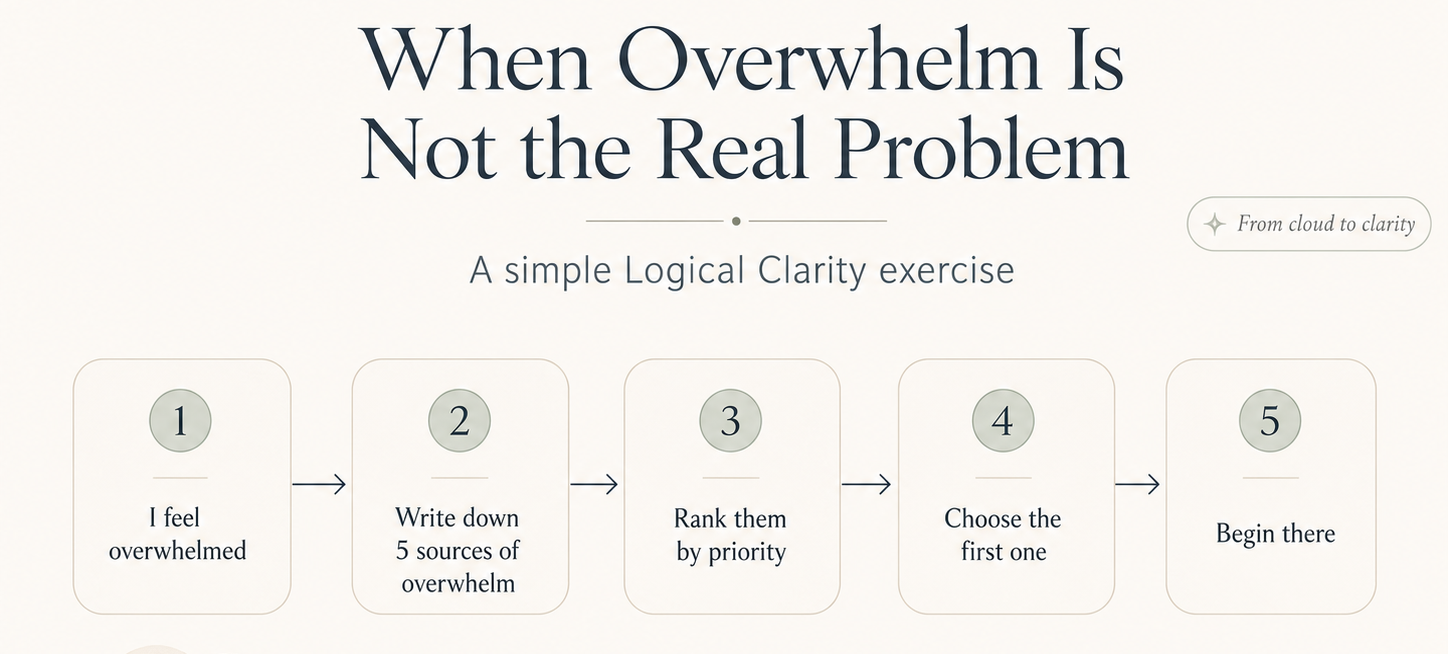
When overwhelm feels too large, begin with a small limit. Write down only five things that are contributing to the overwhelm. Not everything, not the whole life, not every fear and every task. Only five.
This matters because the goal is not to create another overwhelming list. The goal is to make the hidden load visible without expanding it too far. After writing five items, look at them one by one. Ask:
Which one is most urgent?
Which one is creating the most pressure?
Which one blocks the others?
Which one, if handled first, would make the rest easier?
Which one can wait?
Then choose one. This does not mean the other problems disappear. It means they are no longer fighting for attention at the same time. The mind can now see:
This is first. This is next. This can wait. This is not the real priority. This needs more information before action. That is already the beginning of clarity.
The Real Problem May Be Lack of Separation
In many cases, the real problem is not that the person has too many tasks. The real problem is that the tasks have not been separated into a usable order. There is a difference between:
“I have too much to do.”
and:
“I have five things in front of me, but only one needs to be handled first.”
The first sentence creates pressure. The second sentence creates direction. This is why Logical Clarity does not try to solve everything at once. It first asks what kind of problem is present.
Is this a time problem?
Is this a task problem?
Is this a decision problem?
Is this a responsibility problem?
Is this an emotional pressure problem?
Is this a future planning problem?
Once the type of problem becomes clearer, the next step becomes easier to find.
Overwhelm Is Not Failure
Feeling overwhelmed does not mean a person is weak, lazy, incapable, or disorganized by nature. Often, it means they are trying to process too much unstructured reality at once. Modern life can bring too many inputs into one mind: work, family, money, technology, information, uncertainty, and expectation. Without structure, even a capable person can feel blocked.
The Life Organization Framework does not judge overwhelm. It asks what overwhelm contains. It does not begin with motivation. It begins with separation.
It does not say, “You should be able to handle everything.”
It asks, “What exactly needs to be handled first?”
The First Clear Step
When overwhelm appears, the first clear step is not to solve the whole situation. The first clear step is to separate the load.
1. Write down five sources of overwhelm.
2. Rank them.
3. Choose the first one.
4. Let the others wait in visible order.
This simple movement changes the problem. The person is no longer standing in front of one large cloud of pressure. They are standing in front of separate pieces of reality. And once the pieces are visible, logic can begin.
Overwhelm may not be the real problem. It may be the signal that the real problem has not yet been separated.
Closing Note
This publication is part of Marina A. Popova’s Life Organization Framework series, exploring human cognition, AI cognition, and Human-AI cognitive development, organization skills, clarity of thinking. The ideas, structure, and wording are published as part of an ongoing original body of work and should be cited with attribution if referenced, quoted, or discussed elsewhere.
© Marina A. Popova. All rights reserved. First published: June 15, 2026