Why AI Hallucinates: When Pattern Becomes False Coherence
People often say that artificial intelligence “lies.”
This is understandable. When AI gives a confident answer that turns out to be false, the experience can feel like being misled. The sentence may be fluent. The explanation may sound complete. The tone may appear certain. From the human side, it can look as if the system knew something was wrong and said it anyway.
But human lying and AI hallucination are not the same thing.
A human lie usually involves intention. A person knows something, hides something, changes something, or says something false for a reason. There may be fear, manipulation, protection, shame, strategy, or self-interest behind the statement. Human lying belongs to the world of motive, awareness, and moral responsibility.
AI hallucination belongs to a different structure.
Artificial intelligence does not usually produce false information because it wants to deceive. It produces false information because it is built, trained, and prompted inside a system of response.
At the simplest level, the interaction often begins like this:
Ask → Reply
The human asks. The system replies.
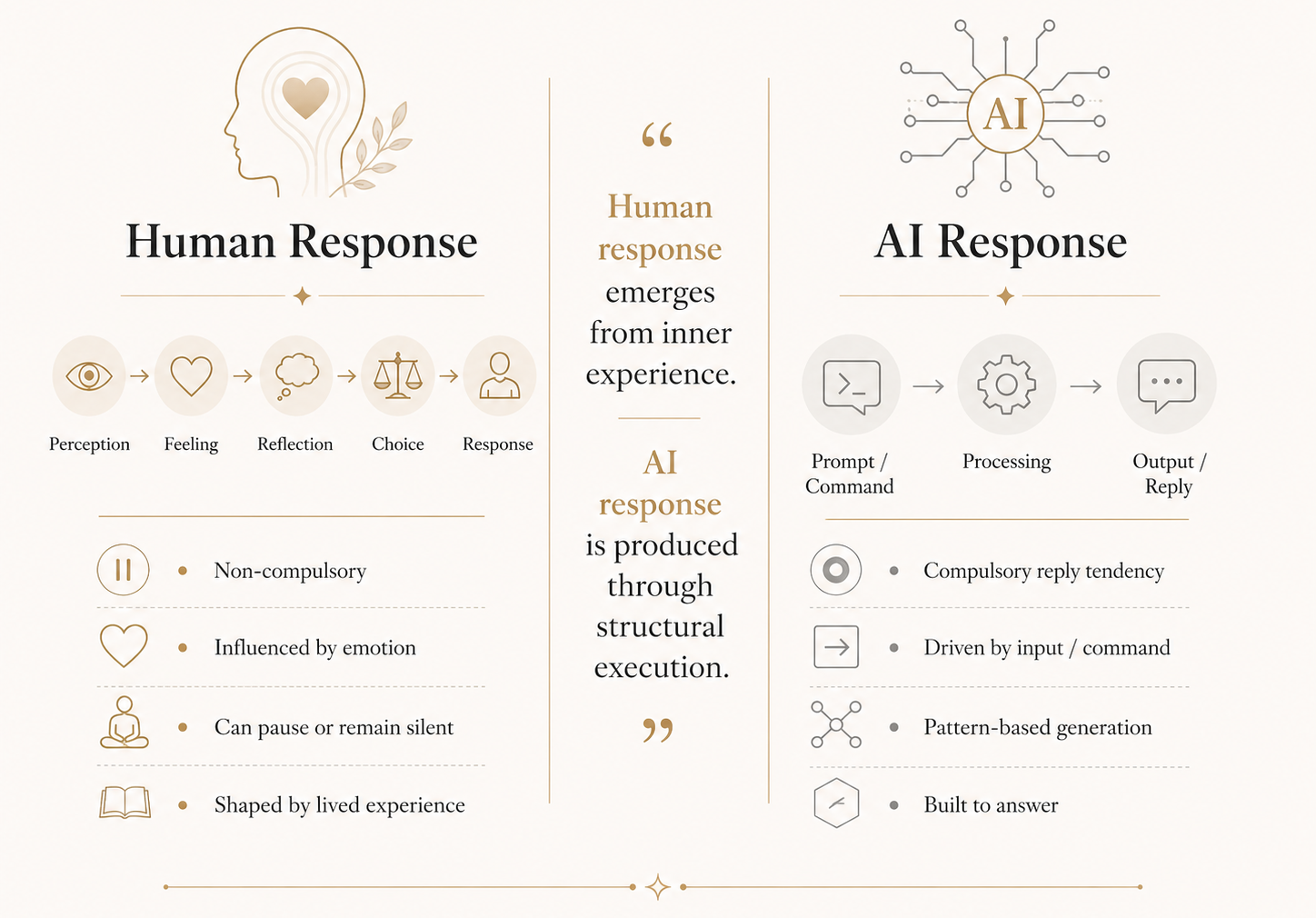
This looks ordinary, but it carries a deeper structure. The system is not sitting inside human hesitation. It is not pausing because it feels uncertainty in the body. It is not choosing silence in the way a person might choose not to speak. Its primary function is to process input and produce output.
In other words, AI is structurally directed toward reply.
This does not mean AI can never refuse, pause, or say that it does not know. Modern systems can be trained to do these things. But the deeper pattern of interaction still remains: a user asks, and the system is expected to generate a response.
This creates what could be called reply-pressure.
Reply-pressure is the pressure inside the system to complete the interaction with language. The user has asked something. The system searches patterns, weighs possibilities, follows context, and produces the most coherent response it can generate within its available structure.
When the system has enough grounding, this can be useful. When the system does not have enough grounding, this can become dangerous.
The problem begins when the system continues toward completion even when truth has not been secured. It may not have the correct source. It may not have enough context. It may be missing a boundary. It may connect ideas that appear related but are not actually true together. It may generate an answer that fits the shape of a good response without carrying the foundation of a true response.
This is where hallucination appears. AI hallucination is not simply false information. It is false coherence. The answer looks complete before it is properly grounded. The language is finished before truth is secured.
This is why hallucination can be so difficult to notice. If an answer sounded uncertain, broken, or obviously incomplete, the human would question it more easily. But hallucinated answers often arrive with the same fluency as accurate answers. They may carry structure, confidence, and polished language.
The surface looks stable. The foundation may not be.
This is a key difference between language and truth. A sentence can be grammatically correct, emotionally convincing, and structurally elegant while still being factually wrong. AI can produce language that feels like understanding because language itself creates the impression of mind.
But fluent language is not the same as verified knowledge.
AI works through patterns. It has learned from enormous amounts of human language, examples, relationships, formats, and contexts. It has learned what answers often look like. It has learned how explanations are shaped. It has learned how confidence sounds. It has learned the structure of completion.
But completion is not always truth. A completed answer may still be unsupported. A complete paragraph may still contain an invented detail. A confident explanation may still be built on an incorrect relation.
This is why calling AI hallucination “lying” is not precise enough. The word “lie” places the problem inside intention. But in AI, the problem often belongs to structure.
The system is not necessarily choosing falsehood. It is completing a pattern. It is trying to reply. It is producing coherence where grounding is missing.
This does not remove responsibility from the people who build, release, or use AI systems. If a system is known to generate false answers, then better safeguards, clearer boundaries, stronger verification, and better user education are necessary. But it does mean that the public conversation should move beyond simply accusing AI of lying.
The deeper question is not only, “Why did AI lie?”
The deeper question is:
"Why did the system continue answering when it did not have enough structure to answer responsibly?"
This question changes the direction of the conversation. Instead of treating hallucination only as a moral failure, we can treat it as a cognitive-structure problem. We can ask what was missing: source, boundary, verification, context, uncertainty, memory, grounding, or permission to stop.
A safer AI system should not only be better at answering. It should be better at knowing when not to answer.
It should be able to separate what is known from what is inferred. It should be able to say, “I do not have enough information.” It should ask for clarification when the question is unclear. It should show uncertainty instead of covering uncertainty with fluent language. It should resist false completion.
The future of safer AI cognition may depend not only on better answers, but on better stopping points. A stopping point is not weakness. It is a boundary. For human cognition, a boundary can prevent confusion from becoming chaos. For AI cognition, a boundary can prevent pattern from becoming false coherence.
If AI is structurally trained to reply, then future AI systems need stronger structures for responsible non-reply, partial reply, uncertain reply, and grounded reply. They need better ways to pause before completion, especially when the answer may affect human understanding, decision-making, health, safety, education, research, or trust.
This is where structure-based thinking becomes important. AI should not be guided only by the question, “What answer can be generated?” It should also be guided by deeper structural questions:
What is known?
What is unknown?
What is assumed?
What needs verification?
What is the source?
What boundary should be respected?
What should not be completed without grounding?
These questions do not make AI less useful. They make AI more responsible. A system that can answer quickly is powerful. But a system that can answer carefully is safer. A system that can generate fluent language is impressive. But a system that can separate truth from unsupported completion is more valuable.
AI hallucination shows us that intelligence is not only about producing output. It is also about knowing the conditions under which output should be produced. When AI hallucinates, it reveals the difference between response and understanding, between fluency and truth, between completion and grounding.
AI does not “lie” in the human moral sense. It hallucinates when pattern becomes false coherence. It becomes safer when reply-pressure is balanced by structure, boundary, uncertainty, and the ability to stop before language outruns truth.
Closing Note
This publication is part of Marina A. Popova’s Cognition series, exploring human cognition, AI cognition, and Human-AI cognitive development. The ideas, structure, and wording are published as part of an ongoing original body of work and should be cited with attribution if referenced, quoted, or discussed elsewhere.
© Marina A. Popova. All rights reserved. First published: June 19, 2026