Why We Have Tools for Writing but Not Tools for Thinking
We have many tools for writing.
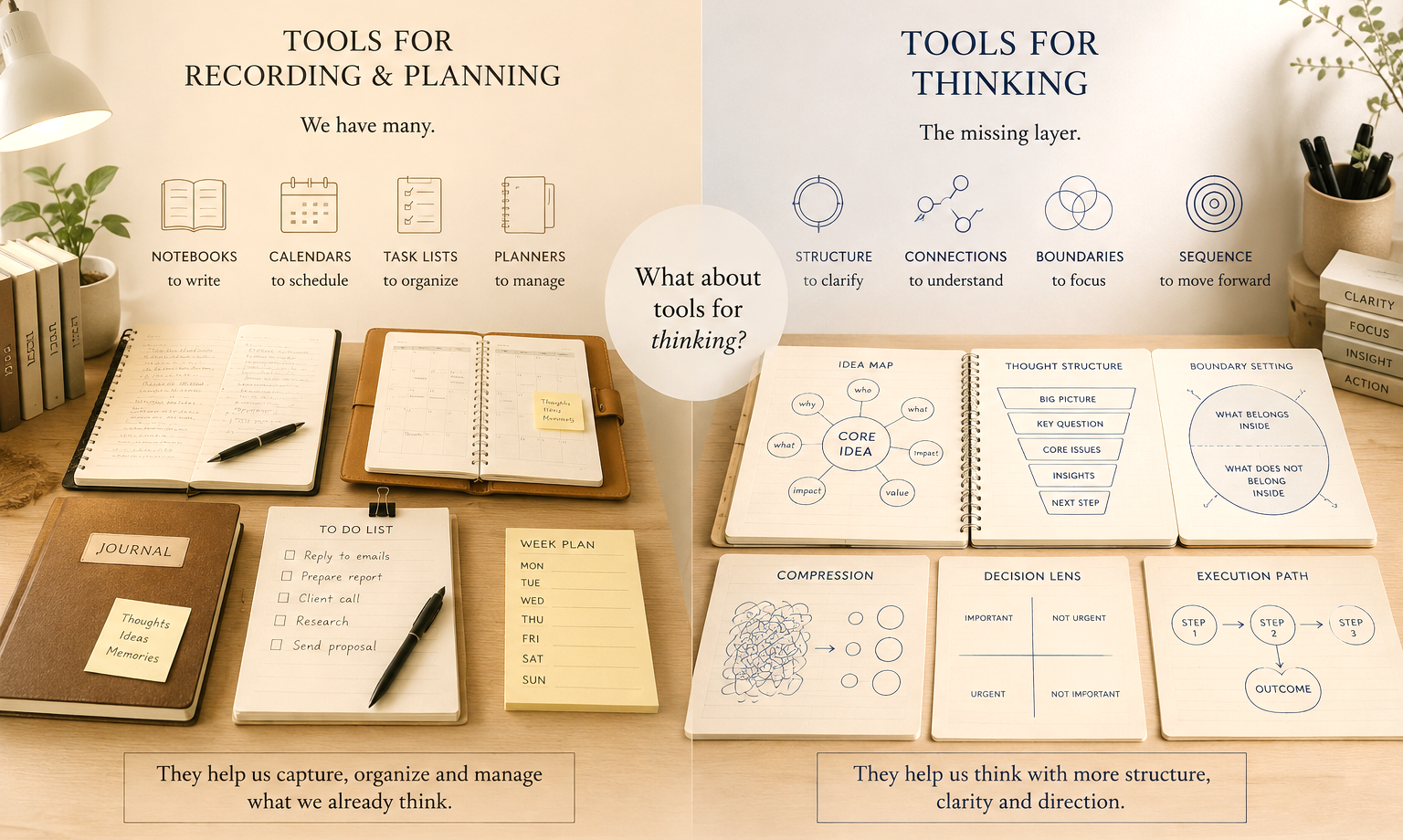
Notebooks, journals, planners, digital documents, calendars, note-taking apps, task lists, templates, and systems designed to help us record what we think. We also have tools for planning. They help us arrange time, manage responsibilities, set goals, track progress, and organize tasks.
We have tools for learning. Books, courses, flashcards, diagrams, summaries, lectures, and digital platforms designed to help us receive and retain information.
But there is a quieter gap between all of them. We have very few tools designed specifically to support the process of thinking itself. Not the result of thinking, not the record of thinking, not the schedule around thinking.
But thinking as it is happening.
The Difference Between Recording and Thinking
A notebook can hold a thought. But it does not necessarily help the thought become clearer. A planner can organize a task. But it does not necessarily help a person understand what problem the task belongs to. A journal can receive emotion. But it does not always separate emotion from logic, urgency from importance, or noise from structure.
Most tools wait for the mind to produce something. Then they store it. But human thinking is often unfinished when it arrives. It may be fragmented, emotional, overloaded, circular, or unclear.
A person may not need another blank page. They may need a structure that helps the thought find its shape.
The Missing Layer
This is where Cognitive Stationery begins. It does not begin from the question:
“How can we write more?”
It begins from a different question:
“How can we think with more structure?”
This distinction matters. Writing is an output. Planning is an arrangement. Learning is acquisition. Thinking is the movement that happens before all of them. If that movement is unsupported, then every later tool receives confusion. The notebook receives confusion. The planner receives confusion. The task list receives confusion. The digital document receives confusion. The tool may be useful, but the thought itself remains unstructured.
Physical Support for Thought
Cognitive Stationery explores the possibility that thinking can be supported physically. Not through decoration, not through motivation, not through more space to write. But through form.
A page can ask better questions. A layout can separate what belongs together from what should not be mixed. A structure can guide attention. A boundary can prevent an idea from expanding endlessly. A sequence can help thought move from uncertainty toward action.
In this sense, a page becomes more than a surface. It becomes a quiet cognitive guide.
Why This Matters
Many people do not struggle because they lack ideas. They struggle because their ideas arrive without structure.
Many people do not fail to act because they are lazy. They fail to act because the thought has not yet become clear enough to execute.
Many people do not need more information. They need a way to organize what is already moving inside the mind.
This is why tools for thinking matter. Because clarity is not always a natural starting point. Sometimes clarity has to be supported.
Toward Cognitive Stationery
Cognitive Stationery is an early exploration of this missing layer. It asks whether physical tools can help guide:
thought formation,
idea development,
problem separation,
emotional positioning,
decision-making,
and cognitive closure.
It is not an attempt to replace thinking. It is an attempt to support it. The purpose is not to make the mind dependent on tools. The purpose is to train the mind to recognize structure. Until, eventually, structured thinking can continue even without the page.
We have created many tools to preserve what we think. Now we may need tools that help us understand how we think. Cognitive Stationery begins there:
not with writing,
but with cognition.
Closing Note
This publication is part of Marina A. Popova’s Cognitive Stationery series, exploring cognitive development through physical tools. The ideas, structure, and wording are published as part of an ongoing original body of work and should be cited with attribution if referenced, quoted, or discussed elsewhere.
© Marina A. Popova. All rights reserved. First published: June 22, 2026