The Box and the Table: A Cognitivity Sculpting Entry-Point Exercise
Table of Contents
Some people think more easily when information is contained. Some people think more easily when information is visible. This Cognitivity Sculpting exercise helps notice where thinking enters more comfortably.
It is not a test of intelligence. It does not decide what a person is capable of learning. It only helps observe the first point of mental comfort: where the mind can begin with less friction.
The Exercise
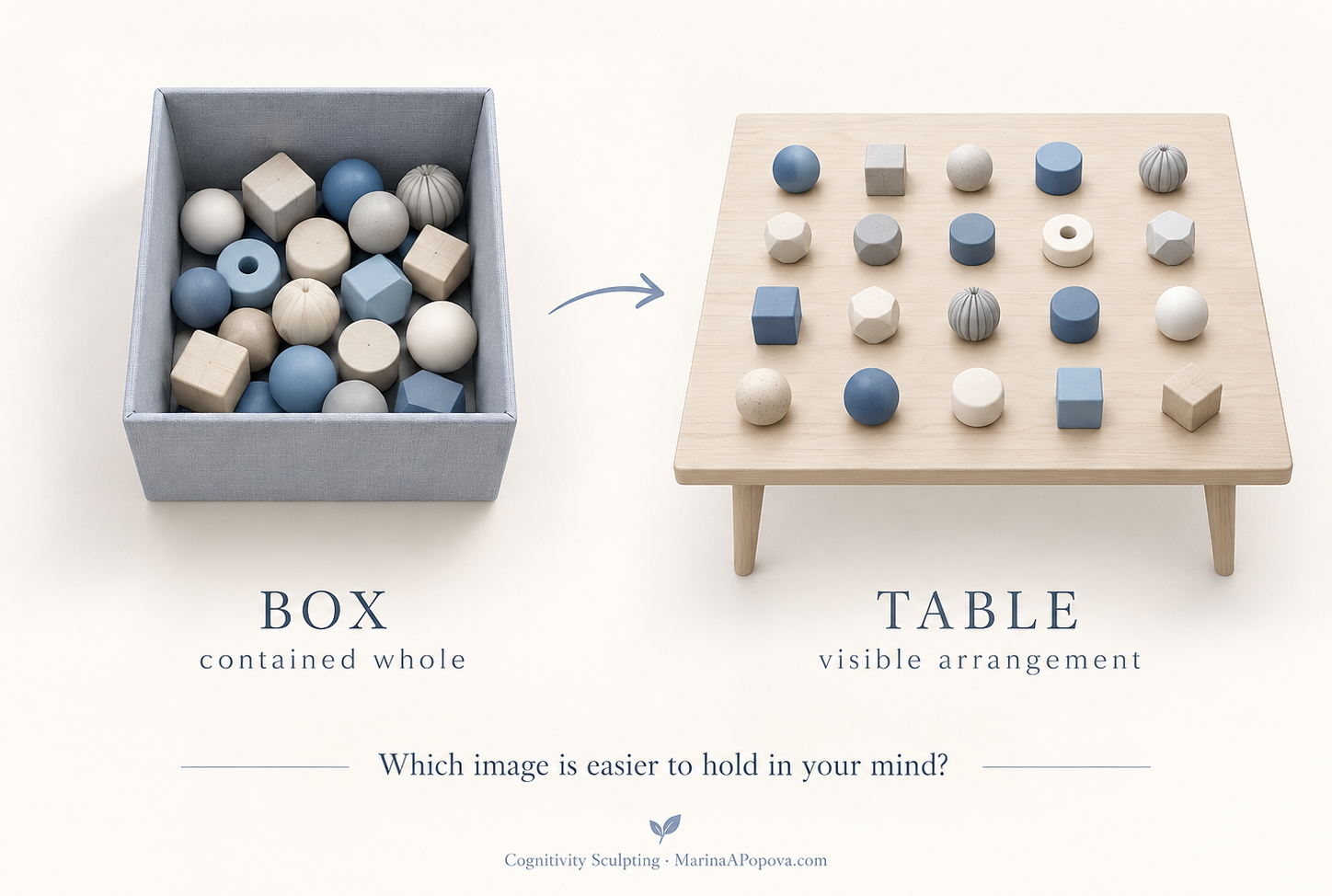
Imagine twenty small objects inside a closed box. They may be buttons, stones, beads, toy blocks, or small pieces of paper. Do not count them one by one yet.
Just hold the image in your mind:
twenty small objects inside a box.
Now imagine opening the box and placing the same twenty objects across a table. They are no longer hidden inside the box. They are spread out where you can see them. Now ask yourself:
Which image is easier to hold steadily in your mind?
The box?
Or the table?
What the Box Shows
The box gives the mind a boundary. Everything is contained. The person does not need to see every object clearly.
They only need to know:
the objects are inside one contained place.
For some learners, this is easier. They may prefer to begin with a bounded "whole" before examining the parts.
The box represent:
Start with containment.
What the Table Shows
The table makes the objects visible. The person can see separation, distance, position, and arrangement. For some learners, this is easier. They may prefer to begin when the parts are visible and spread out.
The table represent:
Start with arrangement.
Moving Between the Two
Now imagine moving the objects back into the box. Then imagine taking them out again and arranging them differently on the table. This movement is important. It helps the mind practice changing between:
contained "whole"
and
visible arrangement.
Both are useful. The box helps hold the whole. The table helps examine the parts.
Why This Matters
When learning a new subject, beginning a project, writing an idea, or solving a problem, people often struggle because they do not know where to start.
Sometimes they need a box. They need a small contained beginning.
Sometimes they need a table. They need the pieces laid out where they can see them.
This exercise helps a learner ask:
Do I need containment first?
Or do I need visibility first?
That small observation can reduce confusion.
Example
A person may say:
I do not know where to begin with this project.
The box approach may ask:
What is the one contained project area I can begin with?
The table approach may ask:
What are all the visible parts of this project?
Neither approach is better for everyone. The exercise simply helps identify the easier entry point.
Final Thought
The mind does not always enter thinking in the same way.
Sometimes it needs a container.
Sometimes it needs a surface.
Sometimes it needs the whole held quietly.
Sometimes it needs the parts placed where they can be seen.
The Box and the Table is a beginner exercise for noticing that difference.
Provenance and Lineage
This post is part of Marina A. Popova’s Cognitivity Sculpting exercise line. It belongs to the wider Human-AI Cognitive Development lineage connected to Cognitivity Sculpting: Foundations of Human-AI Cognitive Development, listed in References as publication record as Marina A. Popova’s 2026 book.
The exercise also aligns with the Human-AI Cognitive Development principle that thought should not move into action before it has been separated, clarified, tested, and structurally held.
How to Cite This Post
Popova, Marina A. (2026). The Box and the Table: A Cognitivity Sculpting Entry-Point Exercise. Author website post. Cognitivity Sculpting / Cognitive Exercises series. First published: September 20, 2026. URL: https://marinaapopova.com/the-box-and-the-table-a-cognitivity-sculpting-entry-point-exercise.html
References:
- Popova, Marina A. (2026). Human-AI Cognitive Development: Origin, Scope, and Authorship Note. Zenodo. DOI: 10.5281/zenodo.22797877
- Popova, Marina A. (2026). Human-AI Cognitive Reasoning Curriculum: Origin, Scope, and Branch Architecture within Human-AI Cognitive Development. Zenodo. DOI: 10.5281/zenodo.22842117
- Popova, M. A. (2026). Cognitivity Sculpting: Foundations of Human-AI Cognitive Development. Balboa Press. ISBN 9798765206737
© Marina A. Popova. All rights reserved. First published: September 20, 2026.